Western Springs has a court-documented sewage problem going back more than fifty years. In the 1970s, a resident at 4419 Clausen Avenue took the village to the Illinois Pollution Control Board over repeated basement floods and sewer backups — water, toilet paper, and human waste erupting through a basement toilet; yard water 12 to 18 inches deep; water entering through the sump pump, windows, and back door; water and paper erupting through a street manhole. The incidents were dated: August 25, 1972; September 17, 1973; April 3, 1974; August 11 and September 24, 1974; April 18–19, 1975; June 12, 1976 — and various dates through August 10, 1980. When a single address can itemize eight years of sewage backups in a legal filing, you understand the combined-sewer stakes in this village.
The infrastructure explains it. Western Springs runs on sanitary and combined sewers, all flowing to MWRDGC's Stickney plant, with four permitted combined-sewer overflows discharging to Flagg Creek — and the village is not connected to the TARP deep-tunnel system in the Flagg Creek watershed, so excess wet-weather flow goes to the creek. The village's own Long Term Control Plan records the scale: in 2008, 62 overflow events totaling 119 hours; in 2009, 78 events totaling 116 hours at a single outfall near 47th Street and Fair Elms Avenue. The village's hazard-mitigation annex lists floods on April 18, 2013, November 17, 2013, and a flash flood on May 11, 2014 — plus water-main repairs required during the severe winters of February 2011 and December 2013 through March 2014. FEMA records one repetitive-loss property in the village. Even the village's famous Water Tower — the 112-foot, 1892 Naperville-limestone tower that houses the police department and jail until 1957 — suffered water damage itself when lightning struck on August 30, 1991: the roof burned, the tank was punctured, and firefighting water damaged the museum interior.
And here's what makes Western Springs losses expensive: this is an affluent village — estimated median house value over $788,000 — of frame "Old Style" homes, brick bungalows, and large newer rebuilds, many with high-value finished basements. An aging combined-sewer core plus finished basements equals high-dollar claims. The village's Overhead Sewer Cost Share Program (launched 2020, focused on the Springdale subdivision at 54th and Howard) signals the recognized basement-backup risk — but the system is still a work in progress. When water gets in, Rapid Water Damage Restoration Illinois answers 24/7. Call (773) 200-3228.
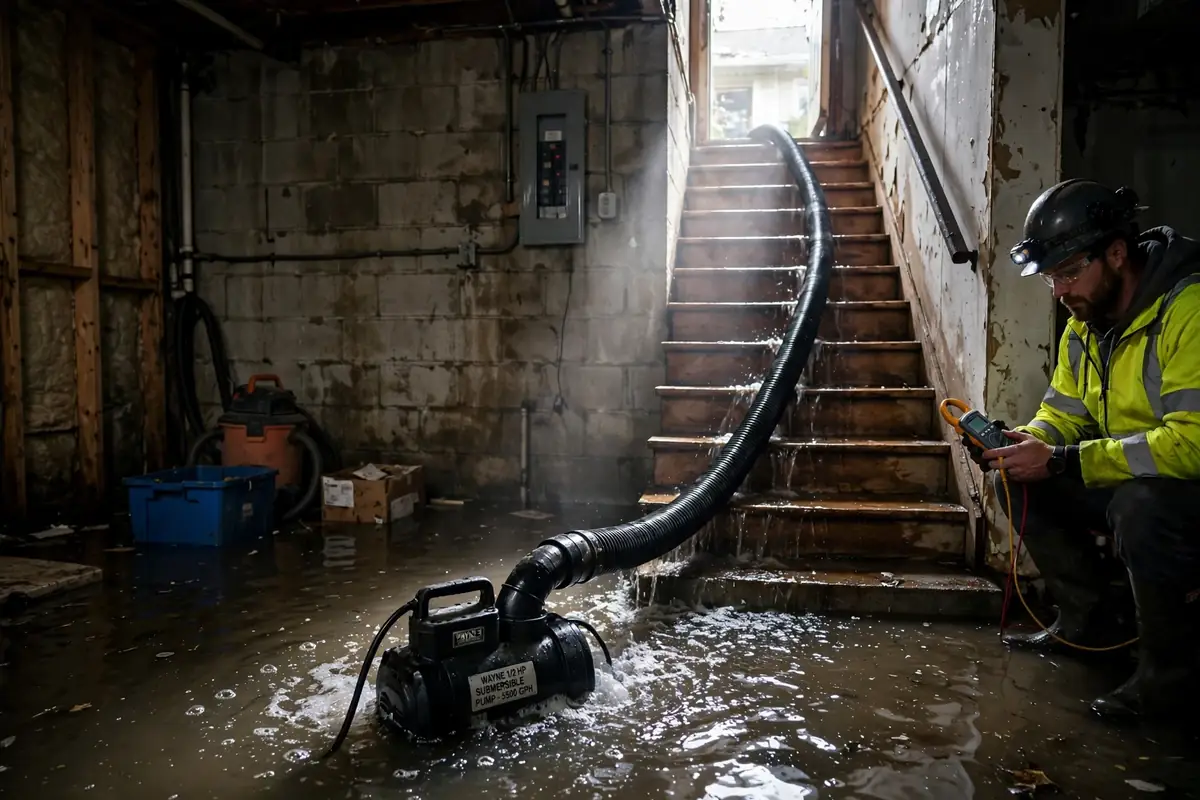
Our Western Springs Water Damage Services
Emergency water extraction
Sewer backup, Flagg Creek overbank, sump failure, burst pipes — high-capacity pump-out with containment for contaminated water, any hour.
Sewage cleanup and sanitization
Combined-sewer backups are this village's signature loss. We extract wastewater, sanitize, dispose of contaminated porous materials, and verify before rebuild.
Structural drying
Monitored drying for century-old frame homes, plaster, hardwood, and high-end finishes — moisture-verified with instruments.
Mold remediation
Finished basements grow mold within days of a backup. We contain, remove, and treat to IICRC standards.
Storm and freeze damage repair
Repairs for stormwater damage and burst-pipe destruction, restored to pre-loss condition — including Old Town homes dating to 1891.
Common Causes of Water Damage in Western Springs
- Combined-sewer backups. Four permitted CSOs discharge to Flagg Creek; the 1972–1980 Clausen Avenue case is the documented local precedent, and wet-weather overflows remain a standing risk.
- Flagg Creek overbank flooding. The village's outfalls feed Flagg Creek near 49th Street, and the creek runs high and fast in storms — Phase 1 of outfall rehabilitation along the creek near Ridgewood was completed in 2021.
- Flash flooding. The village's annex records flood events in April 2013, November 2013, and May 2014; a September 2026 preparedness post had Public Works cleaning catch basins and deploying barricades ahead of 4+ inches of forecast rain.
- Water-main breaks in deep freezes. The hazard annex explicitly records water-main repairs during the February 2011 and 2013–14 winter emergencies.
- Finished-basement exposure. High-value finished lower levels — the village norm — multiply every loss: more material damaged, more of it unsalvageable when sewage is involved.
- Sump and overhead-sewer limitations. Even with the village's cost-share program, homes without overhead sewers or check valves remain the first to flood in surcharge events.
- Aging clay and brick laterals. Old Town and early-1900s homes ride original service lines that crack, shift, and admit roots and groundwater.
Areas We Serve in Western Springs
All of ZIP 60558: Old Town (the 1909 historic core), the Ridgewood subdivision along Flagg Creek, Springdale at 54th and Howard, Springwood Manor / "White Hen," the Grand Avenue business district, Spring Rock Park area, and the 47th Street and 55th Street corridors along the BNSF line, Wolf Road, and Ogden Avenue.
Cost Factors & Insurance Claim Help
No flat quotes — every Western Springs loss is scoped on its facts: water category, square footage and materials affected, how long they stayed wet, and the caliber of finishes. This village's homes skew toward high-end finishes and finished basements, so scope and documentation matter enormously. Many losses here turn on a sewer-backup endorsement or flood-versus-sewer distinctions, so we review coverage with you. Your adjuster gets detailed photo logs and moisture readings to build on, while we handle your insurance company from the first call through the final walkthrough.
How We Restore Water-Damaged Homes in Western Springs
- Call (773) 200-3228 — day or night. We dispatch with extraction equipment, prioritizing active flooding and sewage backups.
- Identify the water's path. Flagg Creek overbank, combined-sewer surcharge, sump failure, or burst line — the source sets the safety protocol.
- Extract under containment. Sewage and creek water get protective protocols and containment before anything else moves.
- Map moisture you can't see. Meters and thermal imaging find water inside finished-basement walls, behind plaster, and under hardwood.
- Dry with logged monitoring. Air movers and dehumidifiers run on a schedule with daily readings until materials hit their targets.
- Restore and document. Pre-loss restoration with full photo documentation for your insurer, from first visit to final walkthrough.
Frequently Asked Questions
What happened on Clausen Avenue in the 1970s?
A resident at 4419 Clausen Avenue documented repeated basement floods and sewer backups — water, toilet paper, and human waste through a basement toilet, yard water up to 18 inches deep, water and paper erupting through a street manhole — on eight dated occasions between 1972 and 1980, and took the village to the Illinois Pollution Control Board. It's the starkest on-record proof that combined-sewer backup is a long-standing local problem, not a new one.
Why isn't Western Springs connected to the Deep Tunnel?
The village's combined-sewer overflows discharge to Flagg Creek, and the village is not connected to the TARP deep-tunnel system in the Flagg Creek watershed. Excess wet-weather flow that exceeds interceptor capacity goes to the creek through the village's permitted outfalls. It's one reason the village's Long Term Control Plan and infrastructure spending focus on local capacity rather than relying on the regional tunnel.
What's the Overhead Sewer Cost Share Program?
A village program (launched 2020, focused on the Springdale subdivision at 54th and Howard) that helps homeowners convert gravity sewer connections to overhead configurations, which protect basements against backups during heavy rainfall. Its existence tells you the village considers basement backup a real, recognized risk — and it's worth asking about eligibility when we assess your home.
Did lightning really damage the Water Tower?
Yes — on August 30, 1991, lightning struck the 1892 water tower (built of Naperville limestone, 112 feet tall, on the National Register since 1981). The roof burned, the tank was punctured, and water from firefighting damaged the interior, which had housed the police department, jail, and municipal offices until 1957 and became the Tower Museum in 1970. It reopened in 1993. Water damage, it turns out, can hit the village's most famous water structure too.
What do the documented winter water-main repairs tell me?
The village's hazard annex records water-main repairs during the February 2011 and December 2013–March 2014 winter emergencies. Combined with the regional record — Chicago's ~5,200 frozen water-service calls in the brutal 2013–14 winter — it means deep freezes are a documented burst-pipe and service-interruption risk here, not just a storm-season problem.
Water Damage in Western Springs? We Respond 24/7
Every minute counts. Rapid Water Damage Restoration Illinois dispatches certified technicians across Western Springs day and night — with insurance documentation handled for you.
Call (773) 200-3228 NowWater Damage Restoration Services in Western Springs
- Our water damage restoration service
- Commercial Water Damage Restoration in Western Springs
- Residential Water Damage Restoration in Western Springs
- Emergency Flood Cleanup in Western Springs
- Storm & Flood Damage Restoration in Western Springs
- Ceiling & Wall Water Damage Repair in Western Springs
- Sewage Backup Cleanup in Western Springs
- Mold Remediation in Western Springs
- Burst Pipe & Leak Water Damage in Western Springs
- Drying & Dehumidification in Western Springs
Nearby Areas We Serve Around Western Springs
Helpful Water Damage Guides
- Sewage Backup Cleanup: Health Risks & Pro Help
- What to Do When Your Basement Floods: A Step-by-Step Emergency Guide
Official resources: FEMA FloodSmart (flood insurance) and EPA guide to mold and moisture.