Brookfield is the town where Salt Creek comes to visit — and stays too long. In 1987, a storm dumped nearly 10 inches of rain on Chicagoland, and the Salt Creek flooding that followed was severe enough that DuPage County built flood-control reservoirs across the basin, including the Elmhurst Quarry reservoir, which holds 2.7 billion gallons. In July 2010, Salt Creek peaked at 14.08 feet on the Wood Dale gage, and USGS crews collected the high-water marks that now calibrate federal flood-inundation maps for the creek. The creek was straightened in the 1960s and 70s, and upstream dams and a diversion tunnel regulate its flows — but flash-rise events still hammer the corridor, and Brookfield sits right in it.
The village's own emergency-management annex reads like a weathered flood diary. Cook County's hazard data puts 117 people and 36 buildings in the 100-year floodplain here, and 504 people and 155 buildings in the 500-year floodplain. Village records name the streets that flood: Custer, Grove, Forest, Prairie, plus the Cantata retirement community and the Hollywood and South Hollywood neighborhoods — South Hollywood includes Village Hall itself. And storms don't only bring creek water: in June 2022, a "microcell" storm damaged more than 2,000 trees, mostly from Ogden Avenue north, hitting homes, cars, and power lines.
Then there's the sewage. Brookfield's storm and sanitary collection system is combined, and the village's own annex puts it bluntly: during heavy rain, undersized pipes cannot handle the capacity, which "floods all the structures connected to the sewer collection system within the Village" — with the warning that "heavy flooding could create a raw sewage hazmat situation." The EPA lists Brookfield's combined-sewer overflow (permit ILM580032) discharging to Salt Creek. And because the village is fully built out, with limited permeable land, runoff has nowhere to go — the surcharge risk concentrates along the Salt Creek-corridor streets named above. The homes there are mostly 1940s–1950s brick bungalows and step ranches, with old clay laterals and original cast-iron stacks — the exact vintage that fails first. When it rains hard in Brookfield, Rapid Water Damage Restoration Illinois answers 24/7. Call (773) 200-3228.
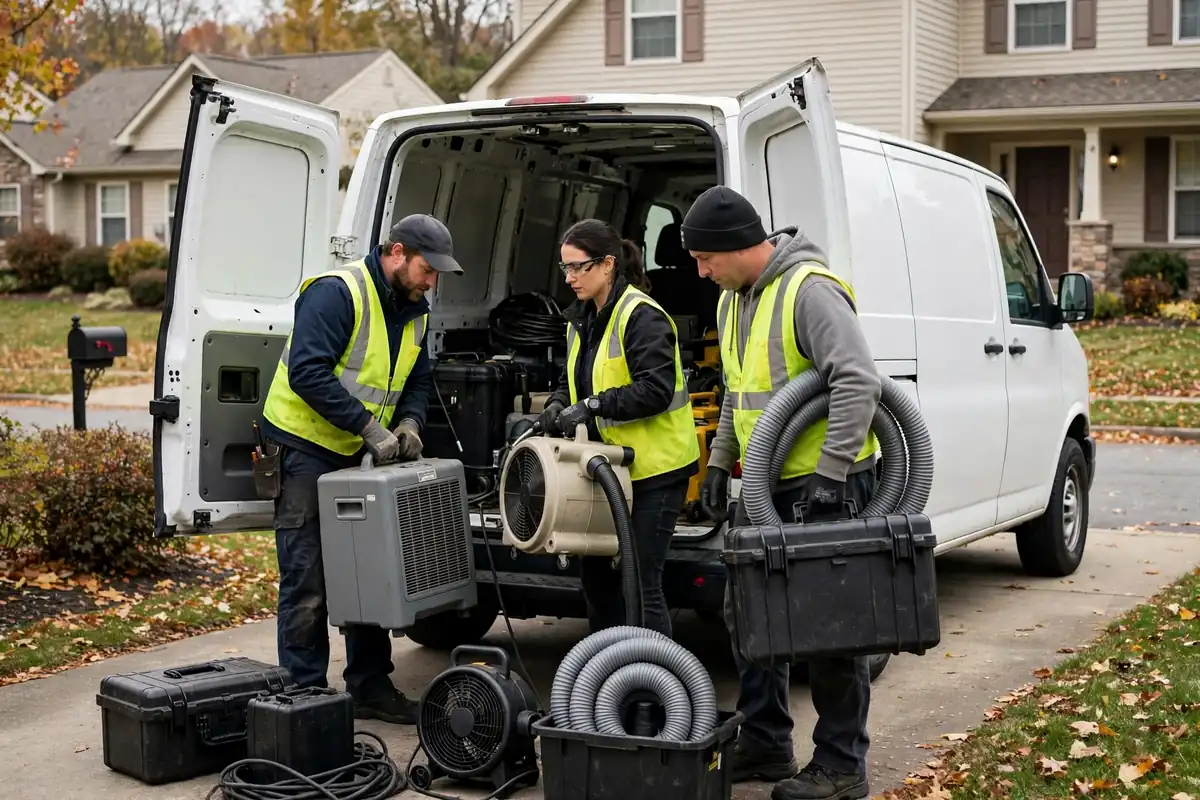
Common Causes of Water Damage in Brookfield
- Salt Creek overbank flooding. The creek's floodway and floodplain cover Custer, Grove, Forest, and Prairie streets and the Hollywood and Cantata areas — 2010-style flash-rise events still hit the corridor.
- Combined-sewer surcharge and raw-sewage backups. The village's own plan warns undersized combined pipes flood every connected structure in heavy rain — potentially a raw-sewage hazmat situation.
- Storm-driven tree and power-line damage. The June 2022 microcell destroyed 2,000-plus trees north of Ogden; a 2011 storm uprooted a huge oak along 26th Place onto a house. Falling limbs breach roofs and siding, letting water in.
- Old clay laterals and cast-iron stacks. 1949-vintage bungalows with aging service lines admit roots and groundwater, and fail outright in surcharged systems.
- Sump pump outages. The hazard annex flags above-ground power lines as a persistent vulnerability; when storms knock out power, electric sump pumps stop at the worst possible moment.
- Freeze-related pipe bursts. Brutal winters like 2013–14 broke century-old mains across Chicago as temperatures cycled — the same vintage infrastructure profile applies to Brookfield's postwar housing stock.
- Limited permeable land. The village is fully built out, so rainfall runs off roofs and pavement instead of soaking in, intensifying street and basement flooding.
Areas We Serve in Brookfield
We respond across ZIP 60513: the Salt Creek corridor streets — Custer, Grove, Forest, Prairie — the Hollywood neighborhood around Village Hall, South Hollywood, the Cantata retirement community, the Eight Corners / Veteran's Memorial Circle area, blocks near Brookfield Zoo Chicago (opened July 1, 1934), Kiwanis Park, Grossdale Station (8820½ Brookfield Ave., National Register 1982), and the Metra Zoo Stop area.
Our Brookfield Water Damage Services
Flood extraction
Salt Creek overbank, street flooding, sewer backup — truck-mounted pump-out with contamination protocols, day or night.
Sewage cleanup and sanitization
Combined-sewer events leave wastewater and everything it touched. We extract, sanitize, dispose of contaminated porous materials, and verify before rebuild.
Structural drying
Monitored drying for brick bungalow plaster, hardwood, and vintage finishes — verified with moisture meters.
Mold remediation
Wall cavities and finished basements grow mold within days of a flood. We contain, remove, and treat to IICRC standards.
Storm damage repair
Roof breaches from fallen trees, wind-driven rain damage, siding repair — restored to pre-loss condition, from 1920s stucco multi-units to 1960s ranches.
How We Restore Water-Damaged Homes in Brookfield
- Call (773) 200-3228 — we're on call around the clock. Active flooding and sewage backups get priority dispatch with extraction equipment.
- Survey the loss. We identify the water's source — creek overbank, sewer surcharge, tree damage, burst pipe — and assess what's salvageable.
- Remove the water safely. Extraction first; sewage and Salt Creek floodwater get full containment and protective protocols.
- Trace hidden moisture. Meters and thermal imaging find water behind plaster, under hardwood, and inside finished basements.
- Dry on a monitored plan. Air movers and dehumidifiers run with daily readings until materials reach their targets.
- Restore and verify. Repairs to pre-loss condition, documented from the first photo to the final walkthrough for your insurer.
Cost Factors & Insurance Claim Help
No flat quotes — every Brookfield loss is scoped on its facts: water category, square footage affected, materials involved, and how long they stayed wet. Sewer-contaminated losses cost more than clean-water ones because sanitization and disposal are mandatory; finished basements multiply scope. Coverage often hinges on a sewer-backup endorsement or the flood-versus-sewer distinction — we review your policy with you. We build your claim file as we work — photo logs, moisture readings — and deal with your insurance company directly from first call to final walkthrough.
Frequently Asked Questions
Which Brookfield streets flood the worst?
The village's own emergency annex names them: Custer, Grove, Forest, and Prairie streets sit in Salt Creek's floodway/floodplain, along with the Cantata retirement community and the Hollywood and South Hollywood neighborhoods — South Hollywood includes Village Hall. If you live on one of these streets, a heavy storm is your standing risk.
What does the village mean by a "raw sewage hazmat situation"?
That Brookfield's combined storm-and-sanitary collection system, in the village's own words, cannot handle heavy-rain capacity — and that the resulting flooding of connected structures "could create a raw sewage hazmat situation." In plain terms: when the pipes surcharge, what backs into basements isn't just water. It requires professional sanitization and safe disposal, not a shop vac.
Didn't DuPage County build reservoirs to stop Salt Creek flooding?
They built them to reduce it — and they help, especially upstream. After the 1987 storm (nearly 10 inches of rain), the county built reservoirs across the Salt Creek basin, including the 2.7-billion-gallon Elmhurst Quarry. But Brookfield sits in the creek's corridor in Cook County, and the 2010 flood still peaked at 14.08 feet on the Wood Dale gage. Reservoirs moderate floods; they don't prevent them.
What's the biggest tree-storm risk to my home?
The June 2022 "microcell" is the template: more than 2,000 trees damaged, mostly from Ogden Avenue north, hitting homes, cars, and power lines. Brookfield's mature tree canopy is a point of pride — and a roof hazard in severe weather. A single breached roof can admit as much water as a flooded basement.
Why do sump pumps fail here during storms?
Because the power fails. The village's hazard annex flags above-ground power lines as a persistent vulnerability, and severe storms that flood basements are the same storms that knock down lines. An electric sump pump without battery backup stops exactly when you need it most — which is why we recommend backup power or water-powered alternatives.
Water Damage in Brookfield? We Respond 24/7
Every minute counts. Rapid Water Damage Restoration Illinois dispatches certified technicians across Brookfield day and night — with insurance documentation handled for you.
Call (773) 200-3228 NowWater Damage Restoration Services in Brookfield
- Our water damage restoration service
- Commercial Water Damage Restoration in Brookfield
- Residential Water Damage Restoration in Brookfield
- Emergency Flood Cleanup in Brookfield
- Storm & Flood Damage Restoration in Brookfield
- Ceiling & Wall Water Damage Repair in Brookfield
- Sewage Backup Cleanup in Brookfield
- Mold Remediation in Brookfield
- Burst Pipe & Leak Water Damage in Brookfield
- Drying & Dehumidification in Brookfield
Nearby Areas We Serve Around Brookfield
Helpful Water Damage Guides
Official resources: FEMA FloodSmart (flood insurance) and EPA guide to mold and moisture.