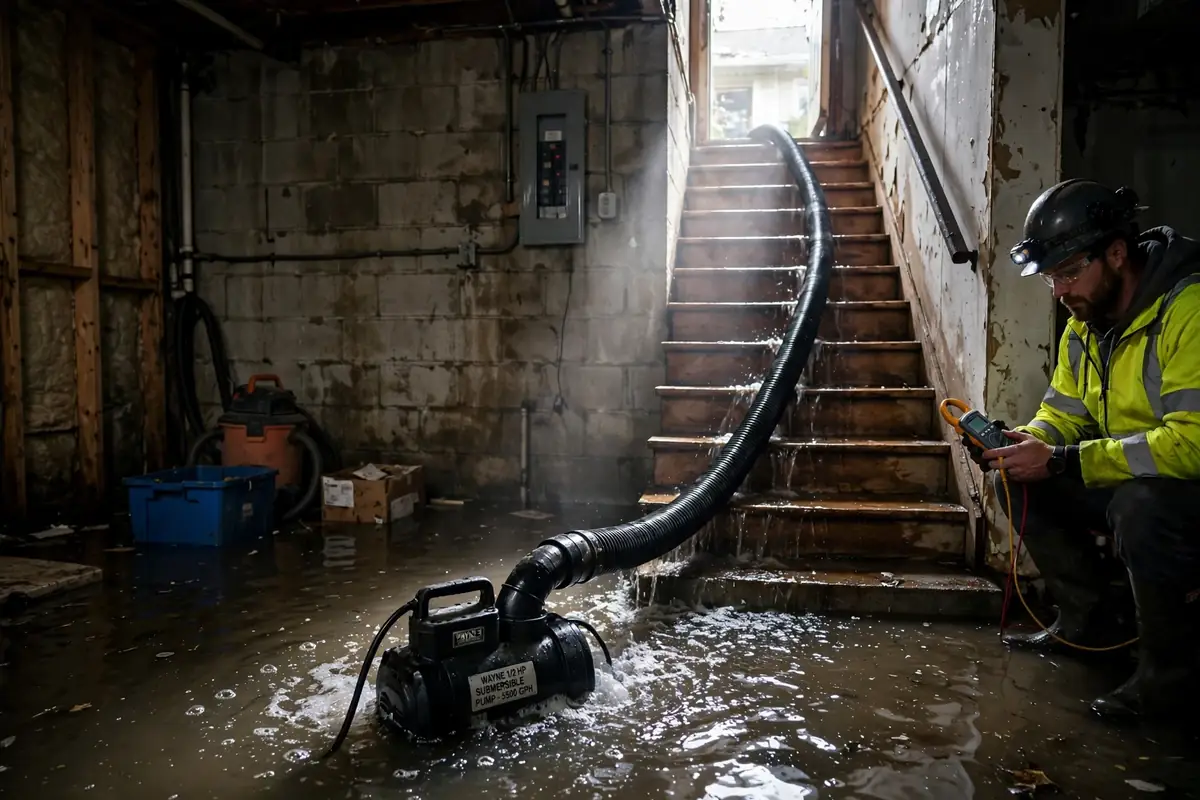
Published · Last updated · Rapid Water Damage Restoration Illinois
On July 2, 2023, a slow-moving storm parked itself over the Chicago metro area and unloaded as much as nine inches of rain in a matter of hours. On the city's west side, as much as three feet of water poured into basements. The mayor's office asked residents to stop taking showers and running dishwashers just to keep more water out of the overwhelmed sewers. More than 70,000 basements flooded across the region that day.
Most of those homeowners had never dealt with a flooded basement and had no plan for the first hour. This guide is that plan. If you're standing at the top of your basement stairs right now, start here — step by step, in order.
Step 1: Protect Yourself — Electricity, Gas, and Contaminated Water
Before anything else: basement floodwater can hurt you. Your safety comes before your drywall and your belongings.
Electricity is the first danger. A flooded basement may carry live current from submerged outlets or appliances. If water covers outlets, cords, or appliances, do not step into it. If your breaker panel is upstairs in a dry spot, shut off the basement circuits before going down. If the panel is in the basement and unreachable without wading, stay out and call an electrician.
Gas is the second danger. If you smell natural gas (rotten-egg odor), leave the house immediately and call your gas utility's emergency line from outside.
The water itself may be contaminated. In Chicagoland, assume the worst: much of the region runs on combined sewers, and what backs up through floor drains during heavy rain can include sewage. Even clear-looking water may carry bacteria or chemicals. Keep children and pets away, wear waterproof boots and gloves, and keep any open cuts out of the water entirely.
If you feel unsafe at any point — deep water, gas smell, sparking sounds — stop and call for professional help.
Step 2: Stop the Water If You Can Do It Safely
Once you're safe, stop more water from coming in. What you can do depends on the source:
- Burst pipe or failed supply line: shut off the main water valve. Every adult in your home should know where it is before an emergency — typically in the basement near where the water line enters.
- Failed sump pump: check whether the pump has power and whether the float switch is stuck — but don't work on electrical equipment while standing in water.
- Storm or sewer backup: there may be nothing to shut off. The water comes from overwhelmed municipal systems and will recede when the system catches up. Your job is documentation and damage control.
If it's a plumbing failure and you can't find or turn the shutoff, call a plumber immediately.
Step 3: Document Everything Before You Start Cleaning Up
This step feels wrong when you're staring at a mess, but it protects your claim. Photograph and video everything before you move a single box.
- Walk the full perimeter on video, narrating what you see.
- Photograph water lines on walls — they show how high the water reached.
- Capture damaged items in place: furniture, electronics, flooring.
- Photograph the source if visible (the burst pipe, the backed-up drain).
- Write down the timeline: when you discovered the water, what you did, and when.
Call your insurer early — but you don't need to wait for an adjuster to begin emergency mitigation. Your policy actually expects you to take reasonable steps to prevent further damage. Rapid Water Damage Restoration Illinois's crews document to insurance standards on every job, from water damage restoration in Chicago to the far suburbs.
Step 4: What NOT to Do
Emergencies breed bad instincts. Avoid these common mistakes:
- Don't wade into water of unknown depth or electrical status. Ankle-deep water over a submerged cord is a hazard you can't see.
- Don't use a household or shop vacuum on contaminated water and assume the job is done — consumer vacuums can't extract water from padding, subfloors, or wall cavities.
- Don't plug equipment into wet outlets or run cords through standing water.
- Don't wait "to see if it dries on its own." Drywall, insulation, and subfloors hold moisture long after surfaces look dry, and hidden moisture is where mold takes hold.
- Don't throw things away before documenting them. Photograph first, discard second.
- Don't assume clear-looking water is clean. In a combined-sewer area, treat all basement floodwater as potentially contaminated.
Step 5: Get the Water Out — and Know When It's Beyond DIY
For a small, clean-water incident caught immediately — a few gallons from an overflowing laundry tub — towels, a wet-dry vacuum, and good airflow may suffice. That's the exception, not the rule.
Call professionals when any of these apply: the water may be contaminated (sewage backup, storm flooding, or any Chicagoland basement flood during heavy rain); water has wicked into drywall or soaked carpet and padding; the affected area is large; you can't identify or stop the source; or you need documentation for an insurance claim.
Professional extraction isn't just bigger vacuums. Crews use commercial extractors, take moisture readings inside walls and under floors, map the full extent of saturation, and place industrial air movers and dehumidifiers sized to the space — then monitor daily and verify materials reach a true dry standard. That verification is what stands between you and a mold problem three weeks from now.
Step 6: Once It's Dry — Keeping It From Happening Again in Illinois
After the emergency passes, Illinois homeowners should think about prevention, because in this state, basement water is rarely a once-in-a-lifetime event:
- Maintain your sump pump. Test it twice a year, keep the pit clear, and consider a battery backup — pumps fail most often during the storms when you need them most.
- Consider a backwater valve. This one-way valve on your sewer lateral lets wastewater out but prevents it from flowing back in during a surcharge — one of the most effective defenses in combined-sewer neighborhoods. Installation requires a licensed plumber.
- Manage water outside. Clean gutters, extend downspouts away from the foundation, and make sure soil slopes away from the house.
- Review your insurance. Standard policies typically exclude flood and often exclude sewer backup without a specific endorsement. After one basement flood, call your agent about both — before the next storm season.