Ashburn's name has a literal origin: the neighborhood was the city's 19th-century ash-dumping ground. Ashburn is one of Chicago's most uniform postwar subdivisions — median year built 1956, with roughly four-fifths of the housing stock built between 1940 and 1969. Thousands of nearly identical brick ranch and raised-ranch homes run on original clay-tile sewer laterals and mid-century sewer mains sized for smaller storms. When a cloudburst overwhelms the combined system, whole blocks of nearly identical homes can back up in the same hour. And these aren't unfinished storage basements: listings routinely show finished lower levels with bedrooms, family rooms, and second kitchens. When Ashburn floods, it floods living space. In the mid-July 1996 deluge, the 18th Ward, "including the Ashburn area," logged 232 flooded-basement calls — one of the highest ward totals on the Southwest Side.
If your basement is taking on water, don't wait. Our IICRC-trained technicians provide 24/7 emergency water damage restoration throughout Ashburn — extraction, structural drying, mold remediation, and sewage cleanup. Call (773) 200-3228 now.
Common Causes of Water Damage in Ashburn
Simultaneous block-wide sewer surcharge. Ashburn's uniformity is its vulnerability: thousands of 1950s brick ranches with the same original clay laterals, feeding the same mid-century sewer mains. When intense rain overwhelms the combined system, entire blocks back up within the same hour.
Mid-century sewers sized for smaller storms. Ashburn's subdivisions were platted and sewered in the 1940s–1960s, when design storms were smaller. Storm intensity has since outrun that capacity, so rain events the system once absorbed now surcharge it.
Finished basements below grade. The raised-ranch listings tell the story: fully finished lower levels with bedrooms and second kitchens. Finished space multiplies every loss — drywall, carpet, and furnishings absorb water that an unfinished basement would shed, and hidden cavities stay wet long after the surface looks dry.
Slab-adjacent and garage-wall plumbing. Raised ranches and split-levels often route plumbing through slab-adjacent walls, attached-garage walls, and unheated utility rooms — all vulnerable in deep freezes. A burst supply line on an exterior wall can run undetected behind finished drywall.
Original galvanized supply lines. Many 1950s–60s Ashburn homes still run on original galvanized steel supply plumbing, which corrodes from the inside and splits when frozen.
Our Ashburn Water Damage Services
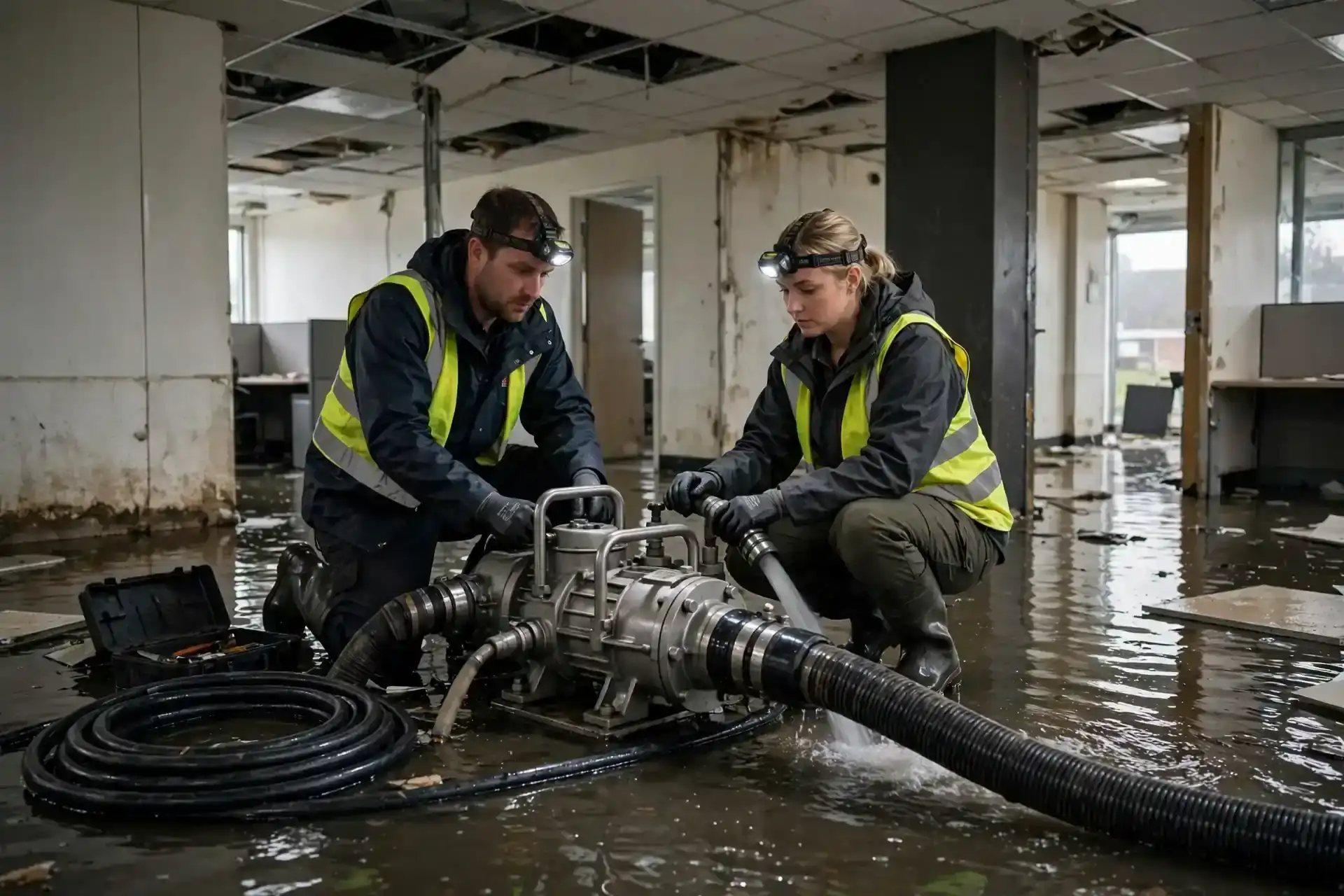
Emergency water extraction. Standing water comes out fast — truck-mounted and portable units clear flooded basements across 60620 and 60652, day or night.
Structural drying for finished lower levels. Finished basements need a different approach: we map moisture with meters and thermal imaging behind drywall and under flooring, then place air movers and dehumidifiers to dry wall cavities, subfloors, and framing to verified dry standards.
Sewage backup cleanup. Surcharge is Ashburn's signature disaster: contaminated water removed under containment, unsalvageable materials disposed of, and antimicrobial treatments applied so finished living space is safe to re-occupy.
Mold remediation. Finished basements are mold's favorite habitat: drywall, carpet backing, and wood framing behind paneling can colonize within 48 to 72 hours. We locate hidden growth, contain it, and remediate to industry standards.
Areas We Serve in Ashburn
We serve the full Ashburn community area — nearly five square miles on the Southwest Side — across ZIP codes 60620 and 60652, from 72nd Street to 87th Street, Western Avenue to Cicero Avenue. That includes the Ashburn Estates, Beverly View, Crestline, Parkview, Scottsdale, and Wrightwood subdivisions, the Pulaski Road commercial corridor and the 79th, 83rd, and 87th Street residential corridors — plus the blocks around Hayes, Scottsdale, and Rainey Parks and the eastern edge by the 60-acre Dan Ryan Woods.
How We Restore Water-Damaged Homes in Ashburn
1. Containment first, then extraction. On arrival we stop the source, isolate affected areas, and check for electrical hazards — then standing water comes out.
2. Protecting your belongings. While extraction runs, we lift, block, or relocate furniture and valuables from finished lower levels.
3. Finding the hidden water. Meters and thermal imaging trace moisture behind finished drywall, under flooring, and inside wall cavities — the visible waterline is rarely the whole story.
4. Drying to verified readings. We place air movers and dehumidifiers matched to your materials and monitor until moisture readings — not appearances — confirm the structure is dry.
5. Decontamination and mold prevention. Affected surfaces are cleaned and treated with antimicrobials; sewage-affected spaces get full decontamination before any rebuild begins.
6. Rebuild and final walkthrough. Damaged drywall, flooring, trim, and paint are repaired or replaced to match your finished space, and we walk it with you.
Cost Factors & Insurance Claim Help
Scope turns on the water category, the rooms and materials affected, how long the structure stayed wet, and whether mold has taken hold. Ashburn's finished basements raise the stakes: flooring, drywall, cabinetry, and furnishings all absorb water.
We work directly with insurance companies every day — photographing damage, logging moisture readings, and building the detailed scope adjusters need. For sewer backup claims, where coverage often hinges on a specific endorsement, thorough documentation keeps your claim moving.
Ashburn Water Damage FAQs
Why do whole blocks of Ashburn back up in the same hour? Because the blocks were built the same way at the same time — roughly four-fifths of Ashburn's housing went up between 1940 and 1969, with original clay-tile laterals feeding mid-century sewer mains sized for smaller storms. When a cloudburst exceeds what the shared infrastructure can carry, the surcharge hits every lateral on the block at once.
My raised ranch's finished basement has a bedroom and a second kitchen. How does cleanup differ from an unfinished basement? Significantly. An unfinished basement is mostly concrete — extract, dry, disinfect, done. A finished lower level with bedrooms and a second kitchen means drywall, insulation, flooring, cabinetry, and possibly appliances all in contact with the water. Sewage-contaminated porous materials generally must be removed, which can mean opening walls and pulling flooring. Moisture mapping tells us what can be saved.
A supply line burst behind my finished basement drywall and ran overnight. How do you find and dry the hidden damage? With instruments, not guesswork. Thermal imaging detects the temperature differences wet cavities create, and moisture meters map how far water traveled inside the wall — often well beyond the visible stain. We open the wall at the wettest points, remove saturated insulation and drywall, dry the framing and cavity to verified readings, and rebuild.
My neighbors and I all have original clay laterals from the 1950s. Is replacement worth considering? It's worth a camera inspection, at minimum. Clay-tile laterals from the 1950s have had seventy years to crack, shift at the joints, and admit tree roots — and a compromised lateral is what turns a street-level surcharge into a basement full of sewage. A camera scope shows the actual condition: root intrusion, offsets, or collapse. Many homeowners add a backwater valve, which blocks the municipal surcharge from entering through the lateral.
Water Damage in Ashburn, Chicago? We Respond 24/7
Every minute counts. Rapid Water Damage Restoration Illinois dispatches certified technicians across Ashburn, Chicago day and night — with insurance documentation handled for you.
Call (773) 200-3228 NowWater Damage Restoration Services in Ashburn
- Our water damage restoration service
- Commercial Water Damage Restoration in Ashburn
- Residential Water Damage Restoration in Ashburn
- Emergency Flood Cleanup in Ashburn
- Storm & Flood Damage Restoration in Ashburn
- Ceiling & Wall Water Damage Repair in Ashburn
- Sewage Backup Cleanup in Ashburn
- Mold Remediation in Ashburn
- Burst Pipe & Leak Water Damage in Ashburn
- Drying & Dehumidification in Ashburn
Nearby Areas We Serve Around Ashburn
Helpful Water Damage Guides
- What to Do When Your Basement Floods: A Step-by-Step Emergency Guide
- Sewage Backup Cleanup: Health Risks & Pro Help
Official resources: FEMA FloodSmart (flood insurance) and EPA guide to mold and moisture.