West Ridge — still called West Rogers Park or North Town — seceded from Rogers Park in 1890 over a park-district dispute known as the "Cabbage War" and was annexed to Chicago on April 4, 1893. Bounded by Howard Street, Ridge/Western/Ravenswood, Bryn Mawr and Peterson Avenues, and Kedzie Avenue plus the North Shore Channel, 60645 holds the Midwest's largest Hasidic community plus large South Asian, Korean, Assyrian, and Rohingya populations.
West Ridge is the only neighborhood in this group fronting the North Shore Channel along its entire western edge — a riverine exposure the other bungalow-belt areas don't share — while sitting atop Chicago's combined sewer system, where rainwater and sanitary flow share the same pipes (MWRD). When those pipes surcharge, water "backs up into streets and basements" — exactly what Devon Avenue showed on September 11, 2022 — manhole covers reported blown off. That night, 2.5+ inches of rain fell in hours and some 2,500 residents across five North Side neighborhoods reported basement flooding.
December reporting named West Ridge's immigrant, non-English-speaking households as the residents least likely to call the city for help — which is why a direct 24/7 line matters. Call (773) 200-3228.
West Ridge water damage FAQs
What does fronting the North Shore Channel mean for my basement? The channel runs along West Ridge's entire western edge, giving the neighborhood a riverine exposure the other bungalow-belt areas don't have. When the channel runs high and the combined sewer system is under pressure at the same time, low-lying basements get hit from two directions. If you live near the channel, watch for seepage after it crests — and call (773) 200-3228 at the first sign.
Manhole covers were blown off on Devon during the 2022 storm — should I worry about my drains? Yes. Blown manhole covers are the visible signature of a surcharged combined sewer — pressure in the shared pipes forcing its way out wherever it can. If that happened on your block, have your floor drains and any backwater valve checked before the next heavy rain.
My sump pump's discharge line runs across the yard. Why is that a winter problem? Those lines can freeze solid in a hard cold snap, and then the pump has nowhere to send the water — so it comes back at your foundation. It's one of the most common winter basement-flooding causes in the bungalow belt. We can advise on rerouting or insulation, and if it already failed, extract and dry the basement.
Water is coming up through my floor drain, but it's barely raining. How? The combined system carries flow from far upstream. Heavy rain miles away can surcharge the shared pipes and push water up through your drains while your street looks dry — and surcharged backup is Category 3 sewage water, so don't wade in it.
I live in a basement apartment. What are the first signs of a backup? Gurgling drains, a sewage odor, or damp spots spreading around floor drains. Move valuables to higher ground immediately and call (773) 200-3228 — don't wait to see how bad it gets.
Common causes of water damage in West Ridge
The lead local cause is the combined sewer system itself. MWRD's description is blunt: rainwater and sanitary flow share the same pipes, and when they surcharge, water backs up into streets and basements — as Devon Avenue's blown manhole covers proved in September 2022.
The second is the housing stock. West Ridge is the archetypal Chicago bungalow belt — one-and-a-half-story face-brick bungalows with stone trim, low-pitched roofs, and full basements, built 1910–1940 — and those full basements tie floor drains into an aging system built for a fraction of today's flow. Two-flats and mid-century apartment buildings along the arterials share the same plumbing math.
The third is the North Shore Channel. Riverine pressure along the entire western edge compounds the sewer problem: high channel water and surcharged pipes at once is the worst-case combination for low-lying basements.
In winter, the bungalow belt's weak points show: crawl spaces and uninsulated rear additions freeze exposed pipes, and sump-pump discharge lines running across yards freeze solid — redirecting water right back at the foundation.
Our West Ridge water damage services
Water extraction:
Rapid removal from bungalow full basements, two-flats, basement apartments, and mid-century apartment buildings along the arterials.
Sewage cleanup:
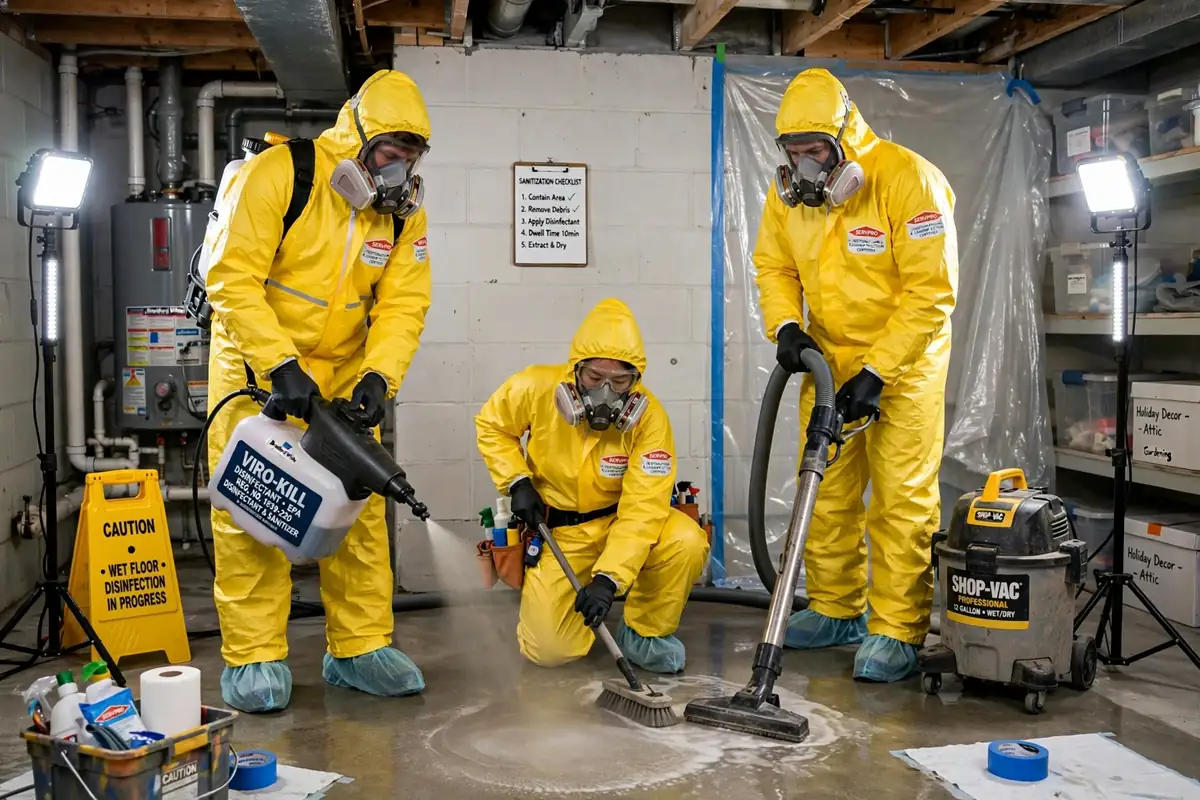
Full Category 3 containment, extraction, and disinfection for combined-sewer backups — the neighborhood's defining loss type.
Structural drying and dehumidification:
Calibrated drying for 1910s–1940s face-brick, vintage plaster, and wood framing, verified with moisture meters.
Mold remediation:
Containment and remediation to IICRC standards for basements that sat in backup water.
Frozen-pipe and sump-line response:
Emergency extraction when discharge lines freeze or pipes burst, plus practical guidance on preventing a repeat.
Cost factors & insurance claim help
Combined-sewer losses are contamination losses: the water's category, how many rooms the backup reached, and whether sewage requires material removal all shape the scope — and we never quote prices sight unseen. What we do is document: photos, moisture logs, and itemized scopes that give your adjuster a verified record from the first call. Basement-apartment tenants and owners alike get the same thorough documentation. We manage the back-and-forth with your insurer so you don't have to, first call to final walkthrough. Call (773) 200-3228 to talk through your situation.
How We Restore Water-Damaged Homes in West Ridge
- Source and safety check. We identify whether it's sewer backup, channel-driven seepage, or a frozen-pipe failure — and we treat surcharged backup as Category 3 from the start.
- Emergency extraction. Standing water is removed immediately, with containment where contamination is involved.
- Moisture mapping and drying. Meters and thermal imaging find hidden damp in brick, plaster, and framing; industrial equipment dries to verified readings.
- Sanitizing and mold remediation. Contaminated areas are disinfected; mold is contained and remediated to IICRC standards.
- Documentation and repair coordination. Itemized records for your insurer, plus coordinated repairs to put the space back.
Areas we serve in West Ridge (60645)
We serve the full 60645 ZIP — plus the 60659 and 60660 pockets at the edges — across a neighborhood bounded by Howard Street, Ridge Boulevard/Western Avenue/Ravenswood Avenue, Bryn Mawr and Peterson Avenues, and Kedzie Avenue with the North Shore Channel beyond. That includes the 15-block Little India stretch of Devon Avenue (with its honorary Golda Meir Boulevard section), Warren Park's nearly 90 acres (home to the Robert A. Black 9-hole golf course and outdoor ice rink), Indian Boundary Park with its field house and nature center, and the Nortown corridor.
Water Damage in West Ridge, Chicago? We Respond 24/7
Every minute counts. Rapid Water Damage Restoration Illinois dispatches certified technicians across West Ridge, Chicago day and night — with insurance documentation handled for you.
Call (773) 200-3228 NowWater Damage Restoration Services in West Ridge
- Our water damage restoration service
- Commercial Water Damage Restoration in West Ridge
- Residential Water Damage Restoration in West Ridge
- Emergency Flood Cleanup in West Ridge
- Storm & Flood Damage Restoration in West Ridge
- Ceiling & Wall Water Damage Repair in West Ridge
- Sewage Backup Cleanup in West Ridge
- Mold Remediation in West Ridge
- Burst Pipe & Leak Water Damage in West Ridge
- Drying & Dehumidification in West Ridge
Nearby Areas We Serve Around West Ridge
Helpful Water Damage Guides
- What to Do When Your Basement Floods: A Step-by-Step Emergency Guide
- Sewage Backup Cleanup: Health Risks & Pro Help
Official resources: FEMA FloodSmart (flood insurance) and EPA guide to mold and moisture.