Norwood Park holds Chicago's oldest house — the Noble–Seymour–Crippen House, built in 1833 and greatly expanded in 1868, the oldest extant building in the city and a Chicago Landmark. The village that grew around it was named for Henry Ward Beecher's 1868 novel, incorporated in 1874, and annexed to Chicago on November 7, 1893. The same mature canopy that makes Old Norwood beautiful threatens its plumbing: a century and a half of tree roots pressing into aging clay sewer laterals, compounded by freeze-thaw stress.
Norwood Park is Community Area 10 — the largest Far Northwest Side neighborhood at 4.29 square miles. The North Branch of the Chicago River borders Norwood Park East, and the Des Plaines River runs just west; homes near the north branch corridor carry the most riverine exposure. But the dominant flood mechanism is combined-sewer surcharge: the July 2010 and April 2013 storms flooded basements across the area, and adjacent Norridge data shows September 13, 2008 dropping 7.26 inches, with 62% of surveyed households reporting sanitary sewer backup.
Rapid Water Damage Restoration Illinois is on call 24/7 across Norwood Park, from Old Norwood's historic blocks to Big Oaks. Call (773) 200-3228 anytime.
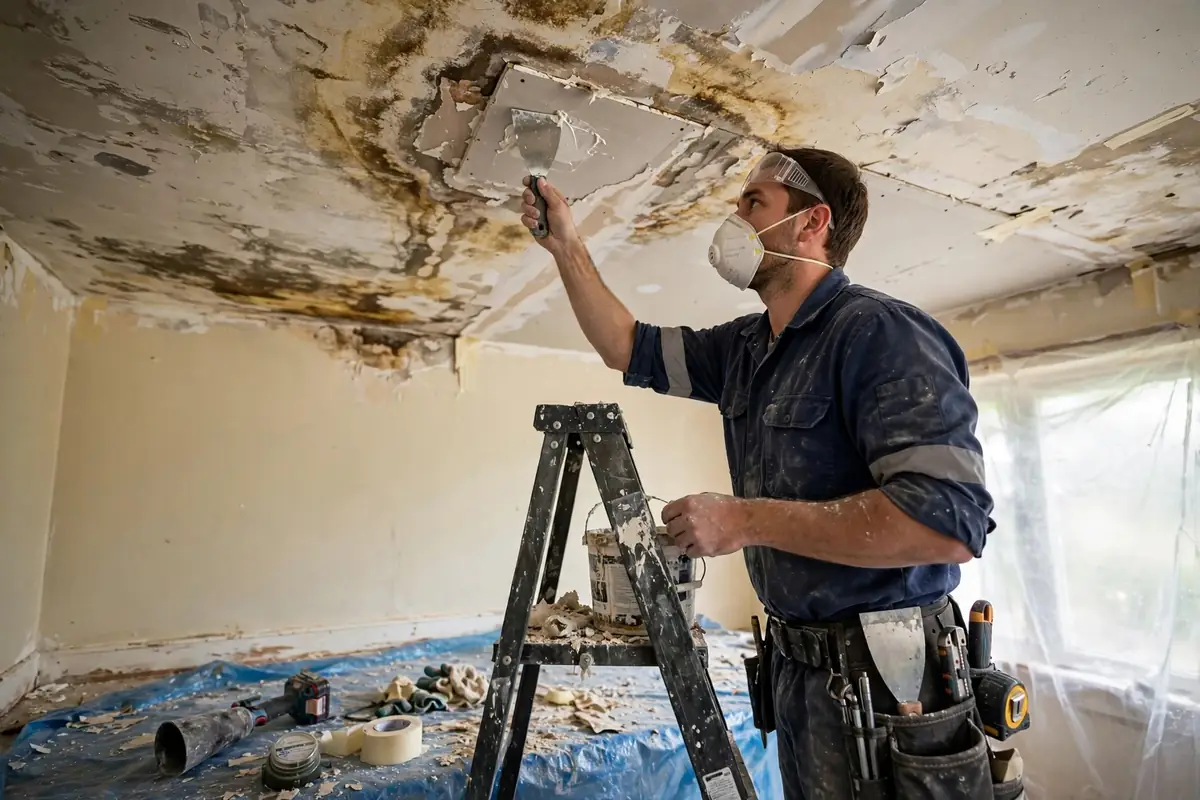
Common Causes of Water Damage in Norwood Park
- Combined-sewer surcharge into basements. Chicago's combined system serves the entire neighborhood; when mains fill beyond capacity, sewage backs up through floor drains and basement fixtures — the mechanism behind the 2008, 2010, and 2013 events.
- Aging clay laterals under a mature tree canopy. Old Norwood's mature trees drive root intrusion into century-old clay laterals, compounding freeze-thaw stress — a documented Chicago-area failure mode that ends in sewage backups.
- North branch corridor exposure. The North Branch of the Chicago River forms part of Norwood Park East's boundary; homes near that corridor and at lower elevations face more riverine influence, especially during regional river crests.
- Low spots near the Kennedy Expressway. The Kennedy cuts through the area along Bryn Mawr Avenue, where low grades and underpasses pond in heavy rain.
- Frozen and burst pipes in pre-war and mid-century stock. Pre-war homes and mid-century bungalows, Georgians, and ranches run original plumbing through unheated spaces; the January 2019 polar vortex (−23°F, wind chills near −52°F) and February 2021 freeze are the reference events.
Our Norwood Park Water Damage Services
Water extraction
Sewer surcharge, river-influenced flooding, burst pipes, sump failures — standing water removed from basements fast, with full containment and protective equipment when sewage is involved.
Structural drying
Historic homes and mid-century bungalows alike need metered drying of masonry, plaster, and framing. Commercial air movers and dehumidifiers run until readings confirm dry.
Mold remediation
Basements that sat damp after a surcharge event — or dried with nothing but fans — grow mold behind paneling and under flooring. We contain, remove, and treat to IICRC standards.
Sewage cleanup
Combined-sewer backup is contaminated water. We extract wastewater, disinfect affected surfaces, and remove unsalvageable materials safely.
Storm damage repair
From historic-district homes to Big Oaks bungalows, we repair water-damaged drywall, flooring, and finishes and rebuild to pre-loss condition.
Areas We Serve in Norwood Park
We cover the full Norwood Park community area — ZIP codes 60631, 60646, and 60656 — including Big Oaks, Norwood Park East, Norwood Park West, Old Norwood Park, Oriole Park, and Union Ridge. Our crews run the five diagonals — Higgins, Talcott, Avondale, Northwest Highway, and Milwaukee Avenues — plus Harlem Avenue and the Devon, Foster, and Bryn Mawr corridors. Landmarks nearby: the Noble–Seymour–Crippen House (1833), the Norwood Park Historical District, Superdawg Drive-In on Milwaukee Avenue, Taft High School (the real-life inspiration for Grease), and Union Ridge Cemetery. The Metra Union Pacific Northwest Line runs through the area.
How We Restore Water-Damaged Homes in Norwood Park
- Emergency call and dispatch. (773) 200-3228 is answered 24/7. We identify the water source — surcharge, lateral failure, riverine influence, or burst pipe — and make the scene safe.
- Extraction and containment. Standing water comes out first. Sewer backups get containment, protective equipment, and source-tracing so we fix the pathway, not just the puddle.
- Moisture mapping. Meters and thermal imaging find hidden saturation in historic masonry, wall cavities, subfloors, and crawlspaces.
- Drying and dehumidification. Equipment matched to the building's materials runs until moisture readings confirm true dry — not touch, not guesswork.
- Cleaning, sanitizing, and mold treatment. Contaminated surfaces are disinfected; mold is contained and removed to IICRC standards.
- Repairs, documentation, and walkthrough. Damaged materials are restored to pre-loss condition, photographed and logged for your insurer, and we walk the completed job with you.
Cost Factors & Insurance Claim Help
We scope every job on its facts — no flat prices: water category (clean pipe water versus combined-sewer backup), rooms and materials affected, how long they stayed wet, and whether historic or vintage features need specialized handling. Because Norwood Park losses often involve sewer backup, we document the water's category and entry pathway precisely: that determines coverage, and sewer backup often hinges on a specific endorsement. We run point with your insurance company from the first call all the way to the final walkthrough.
Frequently Asked Questions
Union Ridge is one of the highest points in Cook County. Can my house there still flood?
Yes — the dominant flood mechanism here is combined-sewer surcharge, which comes up through floor drains, not over the threshold. Elevation drains the yard; it doesn't protect the drain.
Big Oaks was a golf course until the early 1950s. Does that history matter for my basement?
It can. Hundreds of homes were built on demolished golf-course land, and converted open land often carries grading and drainage quirks that show up as ponding and foundation seepage decades later — on top of 1950s-era clay laterals.
What does the 1833 Noble–Seymour–Crippen House have to do with my plumbing?
It marks how old this neighborhood's infrastructure roots run. Many blocks still run on service lines and laterals laid generations ago, now stressed by a mature tree canopy's roots and decades of freeze-thaw cycles. Historic character above ground often means historic plumbing below it.
The North Branch forms part of the Norwood Park East boundary. Is my risk river flooding or sewer backup?
Mostly sewer backup. The North Branch corridor carries real riverine exposure during regional crests, but the signature events — 2008, 2010, 2013 — were combined-sewer surcharge flooding basements across the whole community area.
Where does expressway runoff go in Norwood Park?
The Kennedy Expressway (I-90) was routed in the 1950s to avoid the heart of Old Norwood. Expressway grades and underpasses concentrate stormwater; surrounding low spots pond when overwhelmed, and nearby blocks take the overflow through window wells and below-grade entries.
Water Damage in Norwood Park, Chicago? We Respond 24/7
Every minute counts. Rapid Water Damage Restoration Illinois dispatches certified technicians across Norwood Park, Chicago day and night — with insurance documentation handled for you.
Call (773) 200-3228 NowWater Damage Restoration Services in Norwood Park
- Our water damage restoration service
- Commercial Water Damage Restoration in Norwood Park
- Residential Water Damage Restoration in Norwood Park
- Emergency Flood Cleanup in Norwood Park
- Storm & Flood Damage Restoration in Norwood Park
- Ceiling & Wall Water Damage Repair in Norwood Park
- Sewage Backup Cleanup in Norwood Park
- Mold Remediation in Norwood Park
- Burst Pipe & Leak Water Damage in Norwood Park
- Drying & Dehumidification in Norwood Park
Nearby Areas We Serve Around Norwood Park
Helpful Water Damage Guides
- Sewage Backup Cleanup: Health Risks & Pro Help
- How to Prevent Frozen and Burst Pipes During an Illinois Winter
Official resources: FEMA FloodSmart (flood insurance) and EPA guide to mold and moisture.