Normal's two worst floods arrived five years apart. On the evening of June 25, 2021, four to seven inches of rain fell in about four hours, part of a six-to-eleven-inch storm total. The maximum — 10.71 inches a mile and a half east-southeast of Bloomington — was classified a 1,000-year rainfall. Kickapoo Creek hit record levels, flooding homes in Lawndale; a section of the I-55 shoulder collapsed near the creek; and more than 52,000 families were impacted across McLean County, with a Multi-Agency Resource Center opening at Bloomington Junior High School on July 17–18, 2021.
Then came August 13–14, 2026: severe storms with strong winds, heavy rain, and flooding. The Normal Fire Department set a record for the most calls in a single 24-hour shift; McLean County EMA collected more than 400 residential damage claims — "a bulk of them" in Bloomington-Normal — submitting $42.5 million in damages; and on September 16, 2026, the governor requested a presidential major disaster declaration from FEMA for McLean and seven other counties. River, storm, sewer, or burst line — Rapid Water Damage Restoration Illinois answers 24/7 in Normal. Call (773) 200-3228.
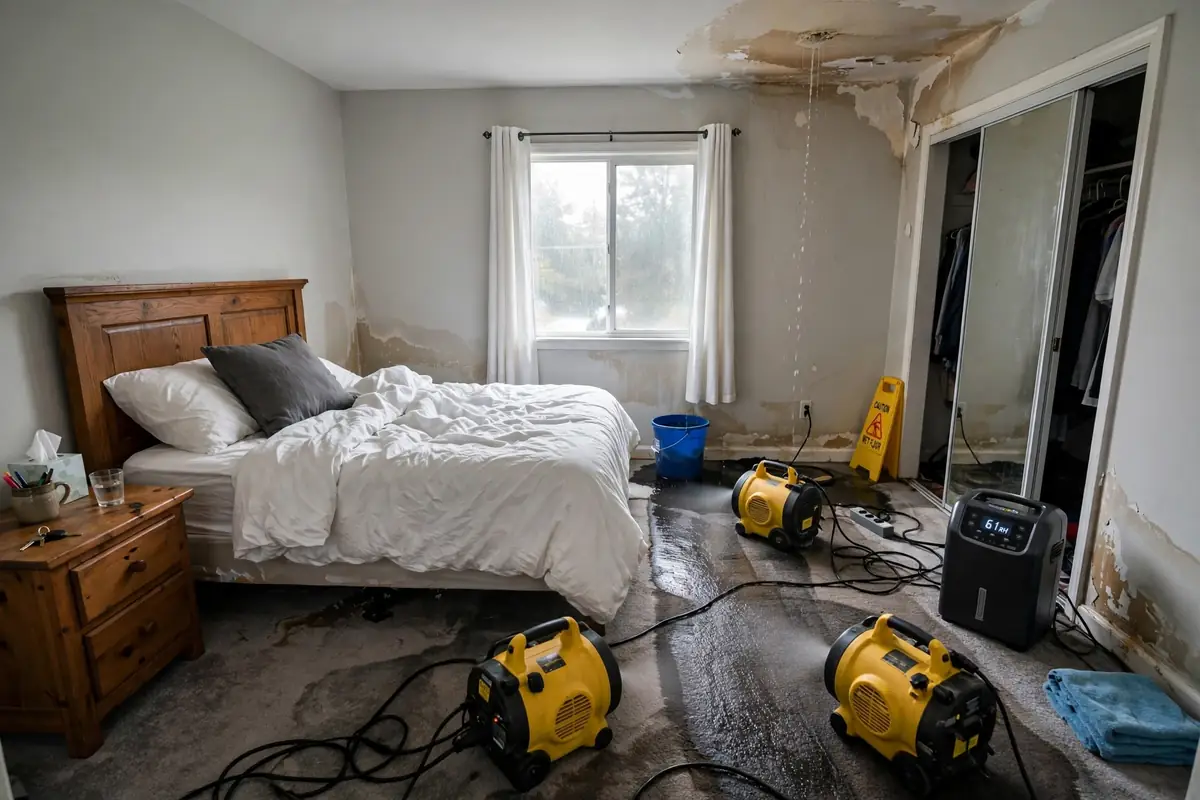
Common causes of water damage in Normal
- A creek that wanders. Normal sits in the Sugar Creek watershed, draining through outfalls to Sugar Creek, Little Kickapoo Creek, Money Creek, Six Mile Creek, and Kings Mill Creek. Town documents note Sugar Creek conveys runoff "in and out of the Town of Normal several times" — so creek flooding can reach town from multiple directions at once.
- The thousand-year rainfall of June 25–26, 2021. NWS Lincoln reports 4–7 inches in about 4 hours and storm totals of 6–11 inches, peaking at 10.71 inches 1.5 miles east-southeast of Bloomington. A second wave on July 16–17, 2021 dropped another 6–8 inches on already saturated soils between Heyworth, Downs, and LeRoy.
- The August 13–14, 2026 storms. Record single-shift call volume for the Normal Fire Department; more than 400 residential damage claims county-wide, the bulk in Bloomington-Normal; and $42.5 million in damages now in the FEMA disaster-declaration pipeline.
- Cross-connected sewers. Normal runs separate storm and sanitary sewers — about 180 miles of sanitary and 102 miles of storm — but a 1950s-era development boom left private cross-connections admitting stormwater into the sanitary system. A correction program fixed about 85% of known private cross-connections; aging private laterals remain a risk.
- The Bloomington-side contrast. Neighboring Bloomington operates combined sewers with an active CSO elimination program at Locust/Colton and Maizefield. The twin city runs two different systems — CSO-era infrastructure on the Bloomington side, surcharge and cross-connection risk on Normal's — and two different claim profiles.
- A burst main on North Street. In late 2024, a Town of Normal water main broke and flooded part of North Street near Uptown Normal and ISU's Watterson Residence Hall — water broke through the pavement around 8 p.m., and crews had the street excavated by 10 p.m.
- New construction tells you something. Town rules may require overhead sewer service on new construction — a quiet municipal admission that basement-backup pressure is a persistent condition here.
Areas we serve in Normal
We respond 24/7 across Normal in ZIP 61761: Uptown Normal, the Illinois State University campus and its student housing corridors — Fell Avenue, School Street, Franklin Avenue, Flora Way, and Adelaide Street — plus CollegePlace Uptown at 100 S. Fell Ave, the College Hills corridor, and the neighborhoods around Watterson Residence Hall, the Fell Arboretum, the Children's Discovery Museum, and Miller Park Zoo. Call (773) 200-3228.
Our Normal restoration process
- Call (773) 200-3228 — day or night. Flash flooding, a backing-up basement, or a burst main gets a live answer and an immediate dispatch.
- Find the source, classify the water. Creek floodwater, stormwater through a cross-connected lateral, or clean supply water — the source sets the protocol and the insurance path.
- Extract fast. Truck-mounted and portable extraction clears standing water before it wicks deeper into framing, subfloors, and finished basements.
- Dry to verified targets. Dehumidifiers and air movers run against metered moisture targets — never touch or guesswork — until every material tests dry.
- Sanitize, treat, document. Contaminated surfaces are disinfected, mold-prone materials handled to IICRC standards, and every reading logged for your adjuster.
Water damage services in Normal
Water extraction
Flash-flood intrusion, creek overbank, cross-connection backups, sump failures, and burst mains — high-capacity pump-out around the clock.
Structural drying
Metered drying for mid-century rentals near campus, 1990s–2010s subdivisions, and Uptown's older mixed-use buildings.
Mold remediation
Containment, removal, and treatment for mold in basements, wall cavities, and crawl spaces after flooding or backup moisture.
Sewage cleanup
Cross-connection and surcharge backups bring category-3 water: full PPE, safe removal of contaminated materials, professional disinfection.
Storm damage repair
Tornado and severe-wind damage — torn roofing and shattered windows admitting rain — secured, dried, and rebuilt to pre-loss condition.
Cost factors & insurance claim help in Normal
We don't quote blind — every Normal loss is scoped on its facts: the water category, how much of the structure stayed wet and for how long, and the home's age and materials. Coverage questions run deep here. Backups from surcharged or cross-connected sewers typically need a sewer/sump backup endorsement — standard policies usually exclude them — while overbank creek flooding is a flood-insurance matter, and August 2026 damage may intersect with federal disaster programs depending on the pending declaration. We walk through your coverage before work begins, photograph and log everything, and coordinate with your insurer from first call to final walkthrough.
Frequently asked questions
What made the June 2021 rainfall a "1,000-year" event?
Four to seven inches fell in about four hours on June 25, part of a 6–11-inch storm total. The 10.71-inch maximum — 1.5 miles east-southeast of Bloomington — hit the 1,000-year threshold. Kickapoo Creek set record levels, part of the I-55 shoulder collapsed near the creek, and homes flooded in Lawndale.
What is the status of the FEMA request for the August 2026 storms?
On September 16, 2026, the governor requested a presidential major disaster declaration for McLean and seven other counties, with $42.5 million in county-submitted damages and more than 400 residential claims, mostly in Bloomington-Normal. The declaration was pending as of that request — check current FEMA status before filing, since approval changes which assistance programs apply.
How do cross-connections cause backups in a town with separated sewers?
Separation only works if the pipes are actually separate. Decades of development left private cross-connections admitting stormwater into the sanitary system; Normal's correction program fixed about 85% of the known ones, identified as a major source of surcharge and backups. Aging private laterals and intense rainfall can still overwhelm the rest.
What is an overhead sewer, and why does Normal require it for new construction?
It routes wastewater upward through the basement ceiling instead of a gravity connection below street level, so a surcharged main can't push sewage into the basement. That Normal may require it on new construction is a tacit admission of persistent backup pressure in town.
Water Damage in Normal? We Respond 24/7
Every minute counts. Rapid Water Damage Restoration Illinois dispatches certified technicians across Normal day and night — with insurance documentation handled for you.
Call (773) 200-3228 NowWater Damage Restoration Services in Normal
- Our water damage restoration service
- Commercial Water Damage Restoration in Normal
- Residential Water Damage Restoration in Normal
- Emergency Flood Cleanup in Normal
- Storm & Flood Damage Restoration in Normal
- Ceiling & Wall Water Damage Repair in Normal
- Sewage Backup Cleanup in Normal
- Mold Remediation in Normal
- Burst Pipe & Leak Water Damage in Normal
- Drying & Dehumidification in Normal
Nearby Areas We Serve Around Normal
Helpful Water Damage Guides
Official resources: FEMA FloodSmart (flood insurance) and EPA guide to mold and moisture.