In the July 1996 flood, the Congressional Record's account of the disaster response notes that in Lemont, "the Illinois & Michigan Canal washed into the streets." Read that again: a 19th-century canal — the waterway that built this town — left its banks and ran through town like a river. It's the most Lemont sentence ever written about a flood, and it captures the village's defining exposure: Lemont sits in the Des Plaines River valley along the I&M Canal and the Chicago Sanitary and Ship Canal, with Sawmill Creek and Nettle Creek threading through. When the valley fills, the water doesn't just come from the sky — it comes from the canals themselves.
The April 2013 flood proved the infrastructure is vulnerable too. The Nettle Creek Aqueduct — which carries the I&M Canal over Nettle Creek near Lemont — collapsed after a period of extreme flooding in April 2013; the entire deck, prism, and eastern abutment were dismantled in 2017 over safety concerns. A landmark-scale piece of canal infrastructure, destroyed by water and taken down as unsafe. April 2013 and July 1996 are the modern benchmarks for the whole region, and Lemont felt both in its own way: streets under canal water, an aqueduct in ruins.
The village's identity is quarries and limestone. Digging the I&M Canal, workers struck fine dolomite limestone — "Athens Marble," for Lemont's original name Athens — that built the Old Stone Church and the Chicago Water Tower. Decades of quarrying drew Polish, Bohemian, Austrian, Czech, Italian, German, Irish, and Scandinavian immigrants. Today those flooded former quarries are lakes: The Forge adventure park (opened July 2020, ~300 acres on disused industrial land) uses them as water features around the tallest ropes course in North America at 120-plus feet. It's a beautiful reuse — and a reminder that this village's ground holds water in every direction. The downtown tells the other half: the Lemont Downtown Historic District (National Register, listed September 6, 2016) covers 14 blocks of 1850–1950 commercial buildings along Stephen Street, and near downtown the homes are turn-of-the-century farmhouses, brick bungalows, craftsman houses, and Tudors — many from the early 1900s or before, on roughly quarter-acre lots. Century-old downtown homes often have original plumbing, uninsulated stone or brick foundations, and old service lines — prime freeze-burst and seepage candidates. The valley topography means cold air pooling and shaded north-facing slopes extend freeze exposure; spring thaws drive seepage into old limestone foundations. When water gets in, Rapid Water Damage Restoration Illinois answers 24/7. Call (773) 200-3228.
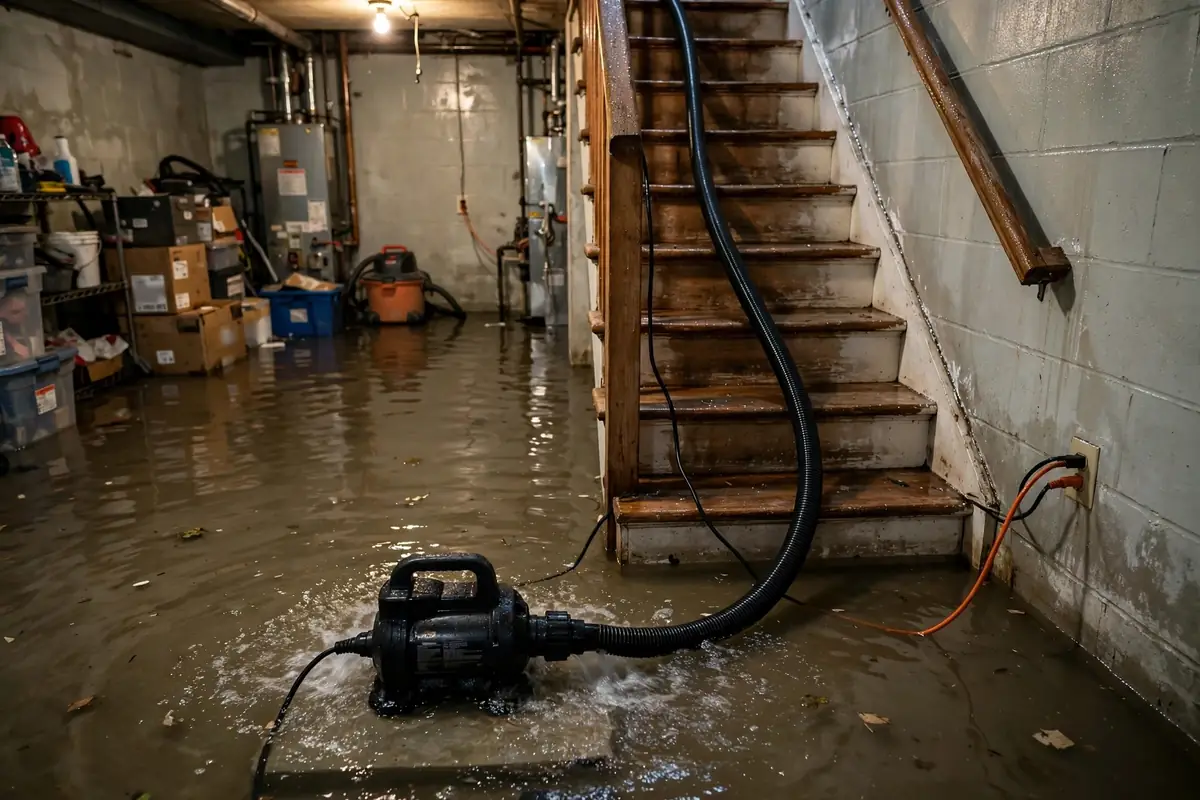
Our Lemont Water Damage Services
Emergency water extraction
Canal and creek flooding, sewer backup, sump failure, burst pipes — high-capacity pump-out with contamination protocols, day or night.
Structural drying for historic and stone construction
Monitored drying for 1900s farmhouses, brick bungalows, limestone foundations, and plaster interiors — verified with meters, never guesswork.
Mold remediation
Old stone and brick foundations with seepage grow mold in wall cavities and basements. We contain, remove, and treat to IICRC standards.
Sewage cleanup
Valley stormwater, canal levels, and the Des Plaines interact in the historic center's aging pipes; backups demand sanitization and safe disposal.
Storm and freeze damage repair
From flood-damaged interiors to burst-pipe destruction in century homes, restored to pre-loss condition — including historic-district character.
How We Restore Water-Damaged Homes in Lemont
- Call (773) 200-3228 — around the clock. We dispatch with extraction gear, triaging active flooding and sewage backups first.
- Trace the water's route. Canal or creek overbank, valley stormwater, sewer backup, foundation seepage, or burst pipe — the source sets the protocol.
- Extract with containment. Standing water comes out; canal, creek, and sewage water get protective protocols before anything else is touched.
- Map moisture in old construction. Meters and thermal imaging find water inside stone and brick foundations, plaster walls, and vintage millwork.
- Dry on a monitored plan. Masonry and plaster dry slowly; we run controlled equipment on logged schedules until readings hit targets.
- Restore and document. Pre-loss repairs with full photo documentation for your insurer — including historic-district-sensitive finish work.
Areas We Serve in Lemont
All of ZIP 60439, across Cook, Will, and DuPage counties: downtown Lemont and the Downtown Historic District (Main, Stephen, Illinois, River, and Front Streets), Stephen Street's historic storefronts, Canal Street near the Metra station and I-355, Northeast Lemont (historic and 1970s–2000s homes near the high school and Metra), Creekwood, Woodglen townhomes, the newer upscale pockets near Cog Hill, and blocks around The Forge: Lemont Quarries Adventure Park, Heritage Quarries Recreation Area, and the Lithuanian World Center.
Common Causes of Water Damage in Lemont
- Canal and creek overbank flooding. The I&M Canal washing into the streets in 1996 is the precedent; Sawmill Creek, Nettle Creek, and the Sanitary and Ship Canal all interact in the valley.
- Des Plaines River valley flooding. The river's long documented flood history applies directly to Lemont's valley floor and low-lying blocks.
- Foundation seepage in old limestone. Century-old downtown homes with uninsulated stone or brick foundations take groundwater every spring thaw — and every sustained wet spell.
- Aging pipes in the historic core. The downtown's legacy infrastructure and valley topography make basement seepage and backup a known risk profile; newer subdivisions run on modern separated systems.
- Aqueduct and canal infrastructure failures. The 2013 Nettle Creek Aqueduct collapse shows canal structures themselves can become the flood source.
- Cold-air pooling and extended freezes. Valley topography pools cold air; shaded north-facing slopes extend freeze exposure for pipes and foundations.
- Frozen sump discharge and irrigation. Newer subdivisions face the standard suburban winter risks: frozen discharge lines and unprotected backflow assemblies.
Cost Factors & Insurance Claim Help
No flat quotes — every Lemont loss is scoped on its facts: water category, square footage affected, materials involved, and how long they stayed wet. Canal and river water is contaminated water, which raises scope; century-old plaster, stone, and millwork dry slower and repair more skillfully than modern drywall. Coverage questions here often turn on flood-versus-sewer distinctions or a sewer-backup endorsement, so we review your policy with you. Detailed photo logs and moisture readings give your adjuster a ready-made file, and we coordinate with your insurance company from the first call to the final walkthrough.
Frequently Asked Questions
Did the I&M Canal really flood Lemont's streets?
Yes — in the July 1996 flood, the Congressional Record's account of the disaster response notes that in Lemont "the Illinois & Michigan Canal washed into the streets." The canal runs through the center of town, and in extreme events it behaves like a river. It's the most place-specific flood image in this village's record.
What happened to the Nettle Creek Aqueduct?
The aqueduct — which carries the I&M Canal over Nettle Creek near Lemont — collapsed after extreme flooding in April 2013. The entire deck, prism, and eastern abutment were dismantled in 2017 over safety concerns. It's landmark-scale proof that floodwater here destroys infrastructure, not just basements.
My downtown home has a limestone foundation. Why does it seep every spring?
Lemont's original building stone is the local dolomite — "Athens Marble" — and century-old stone foundations were rarely waterproofed by modern standards. Spring thaws and sustained rain drive groundwater through mortar joints and stone; the valley topography adds hydraulic pressure. Seepage is a maintenance-and-management problem: interior drainage, sump systems, and grading — plus fast professional drying when it gets ahead of you.
I live in a newer subdivision, not downtown. Am I safe?
Safer, not safe. Newer subdivisions run on modern separated sewer systems and better grading, but they face the standard suburban risks: frozen sump discharge lines, irrigation backflow assemblies, and intense-storm surface flooding. And valley-wide events like 1996's don't check subdivision ages.
What's special about drying a 1900s farmhouse or craftsman?
Everything is slower and more delicate: plaster-and-lath walls, old-growth woodwork, and masonry hold moisture longer than drywall and framing lumber. Aggressive drying can crack plaster and split millwork. We map moisture with instruments, dry with controlled airflow, and verify by measurement — protecting irreplaceable detail while getting the structure truly dry.
Water Damage in Lemont? We Respond 24/7
Every minute counts. Rapid Water Damage Restoration Illinois dispatches certified technicians across Lemont day and night — with insurance documentation handled for you.
Call (773) 200-3228 NowWater Damage Restoration Services in Lemont
- Our water damage restoration service
- Commercial Water Damage Restoration in Lemont
- Residential Water Damage Restoration in Lemont
- Emergency Flood Cleanup in Lemont
- Storm & Flood Damage Restoration in Lemont
- Ceiling & Wall Water Damage Repair in Lemont
- Sewage Backup Cleanup in Lemont
- Mold Remediation in Lemont
- Burst Pipe & Leak Water Damage in Lemont
- Drying & Dehumidification in Lemont
Nearby Areas We Serve Around Lemont
Helpful Water Damage Guides
- How to Prevent Frozen and Burst Pipes During an Illinois Winter
- How Long Before Water Damage Causes Mold?
Official resources: FEMA FloodSmart (flood insurance) and EPA guide to mold and moisture.