Freeport has a water problem that starts underground. Illinois Pollution Control Board hearings document a severe, long-standing sanitary-sewer crisis: roughly 102 miles of sanitary sewers suffer excessive inflow and infiltration — and the Pecatonica River itself infiltrates the sewers when it runs high. The system surcharges and backs sewage into basements; residents in south-middle and northwest Freeport have testified to repeat sewage backups stretching back to the 1960s and 1970s. At times the city has even pumped raw sewage onto streets, near Hunt and Elm Streets, just to relieve the pressure. The Lynn Street lift station can't handle the extra wet-weather flows, compounding backups around Hunt Avenue and Homer Street. This isn't a one-storm problem. It's infrastructure.
The river above ground isn't gentle either. The Pecatonica has flooded Freeport seven times since May 2017, costing the city more than $1.5 million in cleanup — including historic March 2019 east-bank flooding that forced many residents from their homes, and a 15.4-foot crest in October 2019. Add hailstorms nearly every year from 2011 through 2020, two EF-1 tornadoes just west of town in August 2017, and an April 2026 stormfront that ripped an overhang off downtown's Royal Oaks Antiques. Sewage backup, river flood, or storm damage — Rapid Water Damage Restoration Illinois answers 24/7 in Freeport. Call (773) 200-3228.
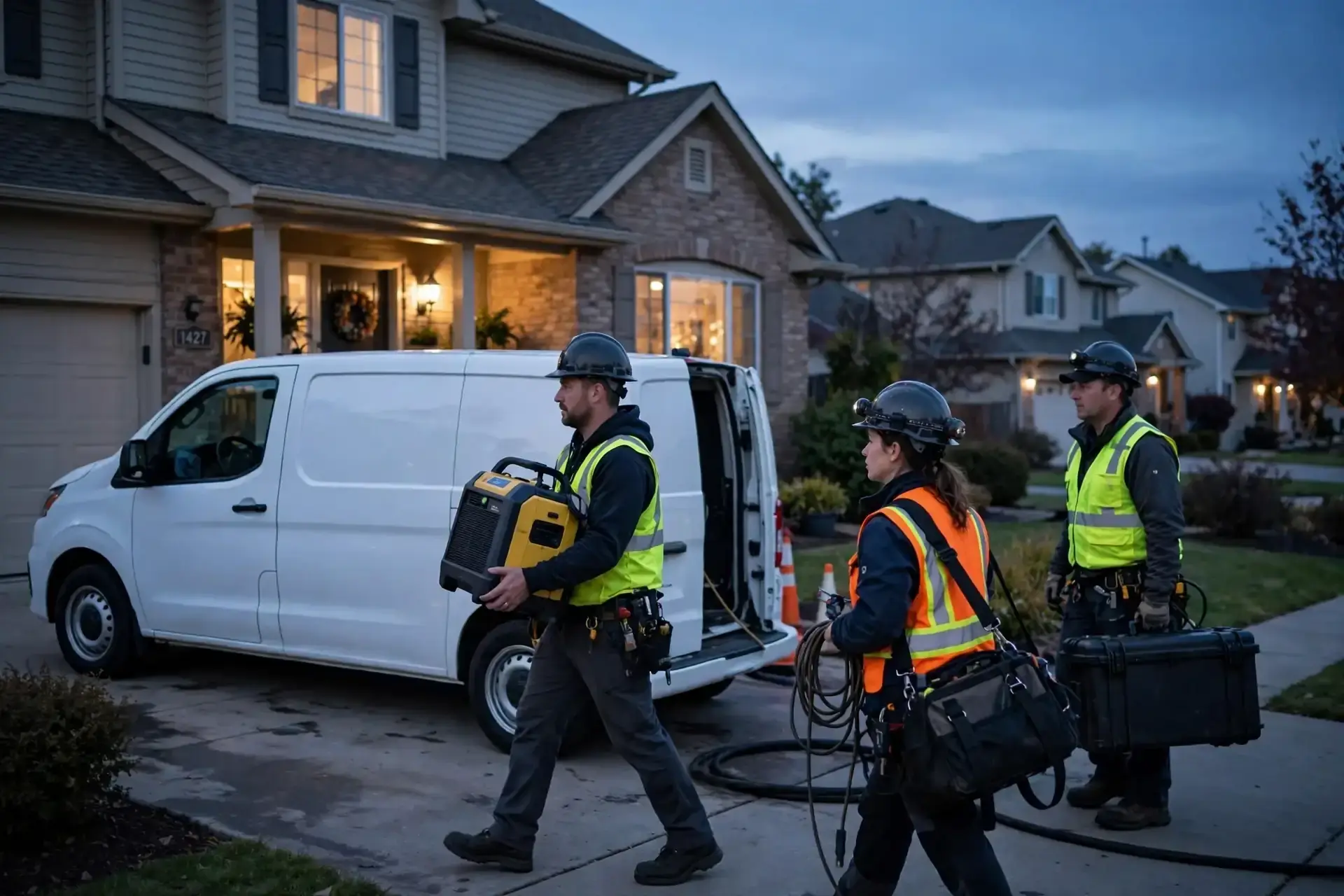
Common causes of water damage in Freeport
- Sanitary-sewer infiltration and surcharge. About 102 miles of Freeport's sanitary sewers carry excessive inflow and infiltration; the Pecatonica River itself infiltrates the sewers when high, the system surcharges, and sewage backs into basements — documented in Illinois Pollution Control Board hearings.
- A lift station that can't keep up. The Lynn Street lift station cannot handle extra wet-weather flows, compounding sewage backups around Hunt Avenue and Homer Street during storms.
- Repeat Pecatonica flooding. The river has flooded Freeport seven times since May 2017, costing the city more than $1.5 million in cleanup. March 2019 brought historic east-bank flooding that forced many residents from their homes; October 2019 reached 15.4 feet (flood stage is 13.0 feet).
- Flood impacts at 15.5 feet. At that level, the NWS reports streets closing north and south of Illinois Highway 75, water entering the first floor of a few homes, Taylor Park beginning to flood, and Van Buren Street businesses north of the river directly affected.
- Hail, wind, and tornado damage. Hailstorms struck nearly every year from 2011 to 2020; two EF-1 tornadoes hit about three miles west of town in August 2017; an April 2026 stormfront tore the overhang off Royal Oaks Antiques downtown; and an April 2026 EF-2 devastated nearby Lena.
- Older homes with basements. Freeport's affordable older stock — 1857 homes with original woodwork, 1907-era houses, brick estates on W Stephenson Street, and the Haight Village Historic District — carries the basements and aging laterals that take water first.
Areas we serve in Freeport
We respond 24/7 across Freeport in ZIP 61032 (area code 815): the Haight Village Historic District, the Taylor Park area, the Krape Park area with its waterfall and paddle boats, Reid Farm, Deer Point Estates, Alpine Ridge, North Highland, Woodbridge Estates, and the neighborhoods around Hunt Avenue, Homer Street, and the Hunt & Elm corridor hit hardest by sewer backups. We work around the landmarks that define the city — the Stephenson County Historical Museum at 1440 S Carroll Avenue, Highland Community College, the Carnegie City Hall, downtown Royal Oaks Antiques, Oakdale Nature Preserve, and the IL-75, Business US-20, and IL-26 N corridors. Sewage in the basement or river water at the door — call (773) 200-3228.
Our Freeport restoration process
- Call (773) 200-3228 anytime. Sewage backups and river floods don't wait — tell us what you're seeing and smelling, and we'll dispatch with the right containment gear.
- Assess: backup or floodwater? We determine whether the water is sanitary-sewer surcharge, Pecatonica overbank, storm runoff, or a clean supply-line failure — the category sets the safety protocol and your insurance path.
- Contain and extract. Category-3 water gets full containment and PPE from the first minute; pumps and extractors remove standing water while we protect the unaffected parts of your home.
- Dry the structure out. Air movers and commercial dehumidifiers run against moisture-mapped targets, with daily meter readings until walls, floors, and framing test dry.
- Treat, rebuild, and document the claim. Flood- and sewage-contacted surfaces are disinfected, compromised porous materials are removed and replaced, mold is remediated to IICRC standards, and every photo and moisture log is packaged for your adjuster.
Our Freeport water damage services
Sewage cleanup
Our signature Freeport service: category-3 extraction in full PPE, safe disposal of contaminated materials, and professional disinfection of every affected surface after sanitary-system surcharge.
Water extraction
Pecatonica overbank, Taylor Park-area flooding, sump failures, or burst pipes — high-capacity pumping for river events and flash flooding alike.
Structural drying
Monitored dehumidification for Freeport's older homes — 19th-century woodwork, brick, and plaster need patient, metered drying verified with daily moisture readings.
Mold remediation
Containment, removal, and treatment where flood or sewage moisture lingers in basements, wall cavities, and crawl spaces.
Storm damage repair
Tornado and wind-driven water intrusion — torn roofs, shattered windows, damaged siding and overhangs — secured, dried, and rebuilt to pre-loss condition.
Cost factors & insurance claim help
We never quote by phone — every Freeport loss is scoped on its facts. The scope depends on the water category (sanitary sewage requires the most extensive sanitation), how much of the structure stayed wet and for how long, and how much porous material must be removed. Freeport homeowners should know the coverage map: sewer backups are typically covered only with a sewer/sump backup endorsement on your homeowners policy — standard policies exclude them — while river overbank flooding is a flood-insurance matter. Given the city's documented sewer history, the backup endorsement is the single most important line on a Freeport policy. We photograph and log everything, review your coverage with you, and work directly with your insurance company from first call to final walkthrough.
Frequently asked questions
Why do Freeport basements back up even when it hasn't rained at my house?
The problem is the system, not your sky. Roughly 102 miles of Freeport's sanitary sewers suffer excessive inflow and infiltration, and the Pecatonica River itself infiltrates the sewers when high. When the system surcharges, sewage backs into basements — residents have testified to repeat backups going back to the 1960s and 1970s. The Lynn Street lift station can't handle wet-weather flows, compounding backups around Hunt Avenue and Homer Street.
Did the city really pump raw sewage onto the streets?
Per the Illinois Pollution Control Board hearing record, yes — at times the city has pumped raw sewage onto streets, including near Hunt and Elm Streets, to relieve pressure on the surcharged system. It's the clearest sign of how severe Freeport's sewer crisis is. If sewage has entered your home, treat it as a health hazard and call (773) 200-3228 — don't wade in.
Has the Pecatonica flooded more often in recent years?
Yes — seven times since May 2017, costing the city more than $1.5 million in cleanup. The state climatologist reports Freeport's heavy-rainfall days have increased every decade since 1949 — the wet trend behind the repeat floods, including the historic March 2019 east-bank flooding and the 15.4-foot crest of October 2019.
Freeport wants to buy out flood-prone homes — what does that mean for me?
The city is seeking funding to buy out homes in flood-prone neighborhoods; one cited study estimates every $1 spent relocating residents saves $6 in future cleanups. If your property sits in a repeat-flood zone, a buyout could eventually be an option — but until then, plan for the next crest: a backup endorsement on your policy, a working sump system, and a restoration crew on speed dial.
What happens to Taylor Park and the Van Buren Street businesses in a flood?
October 2019 is the reference point: the Pecatonica reached 15.4 feet, and the NWS says that at 15.5 feet, streets close north and south of Illinois Highway 75, water enters the first floor of a few homes and begins entering Taylor Park, and Van Buren Street businesses north of the river are directly affected. In that corridor, 15 feet on the gauge is your cue to act.
Water Damage in Freeport? We Respond 24/7
Every minute counts. Rapid Water Damage Restoration Illinois dispatches certified technicians across Freeport day and night — with insurance documentation handled for you.
Call (773) 200-3228 NowWater Damage Restoration Services in Freeport
- Our water damage restoration service
- Commercial Water Damage Restoration in Freeport
- Residential Water Damage Restoration in Freeport
- Emergency Flood Cleanup in Freeport
- Storm & Flood Damage Restoration in Freeport
- Ceiling & Wall Water Damage Repair in Freeport
- Sewage Backup Cleanup in Freeport
- Mold Remediation in Freeport
- Burst Pipe & Leak Water Damage in Freeport
- Drying & Dehumidification in Freeport
Helpful Water Damage Guides
- Sewage Backup Cleanup: Health Risks & Pro Help
- Does Homeowners Insurance Cover Water Damage in Illinois?
Official resources: FEMA FloodSmart (flood insurance) and EPA guide to mold and moisture.