In DeKalb, 2007 was the year the water came twice. On July 9, three to five inches of rain fell fast: four feet of standing water closed roads, people were rescued from cars, basements flooded across town, a retail store on Sycamore Street took water, and an NIU dorm was evacuated — the gauge at 13th and Sycamore recorded 5.00 inches before overflowing. Then August 23–24: 4.85 inches of rain pushed the South Branch Kishwaukee to its highest level since 1983 and second-highest ever, cresting above 15 feet and submerging parts of the city. Roughly 600 residents were displaced, the NIU campus closed, and on September 25, 2007, President George W. Bush declared DeKalb and five other counties major disaster areas — one of five federal flood-disaster declarations in the watershed (1973, 1974, 1993, 1996, 2007).
DeKalb is a river town with a deep freeze problem, too. The January 30–31, 2019 polar vortex drove wind chills of −50 to −60°F across northern Illinois — Rockford hit a record −31°F — and the ~80-degree thaw that followed cracked water mains and home pipes region-wide. DeKalb's many pre-1980 homes with clay-tile sewer laterals were especially vulnerable to frost-heave separating pipe joints. River flood, flash flood, or burst pipe — Rapid Water Damage Restoration Illinois answers 24/7 in DeKalb. Call (773) 200-3228.
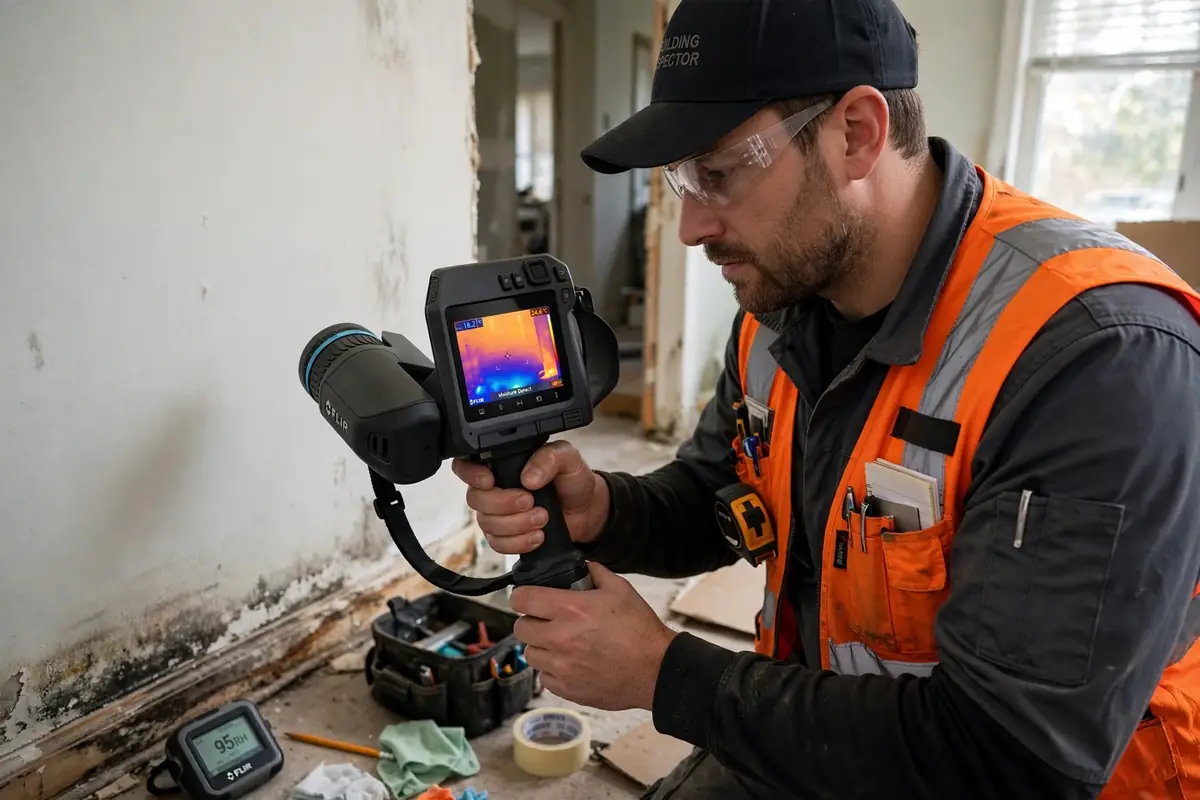
Common causes of water damage in DeKalb
- The South Branch Kishwaukee River. It flows through DeKalb — including the NIU campus near the Art Building — and has risen above its 10.0-foot flood stage nine times since 1926: a record 15.8 feet on July 2, 1983, 12.97 feet in July 1996 (greater than a 25-year event), and above 15 feet in August 2007, second-highest on record.
- Mid-to-late-summer flash floods. Flash flooding can strike low-lying floodplain areas countywide — the July 9, 2007 event (four feet of standing water, a dorm evacuated) is the reference case, and a September 2026 NWS flood advisory for southern DeKalb County shows the risk never left.
- Pre-1980 clay-tile laterals. Homes built before 1980 commonly have clay-tile sewer laterals whose mortar joints degrade — inviting root intrusion, soil infiltration, and sewage backups — while frost-heave cycles can separate the joints entirely. The January 2019 polar vortex was the stress test.
- The East Branch watershed. The East Branch of the South Branch Kishwaukee drains eastern DeKalb; a 2015 watershed plan ties its flooding to conventional stormwater management and channelization.
- A river that takes bridges. On August 19, 2008, DeKalb County's Keslinger Road bridge (SN 019-5010) between First Street and Anderland Road collapsed over the South Branch — a measure of the river's force at high water.
- Tornado damage admitting water. The April 9, 2015 Rochelle–Fairdale EF4 — 200-mph winds, 2 killed, 22 injured — tracked through Lee, Ogle, DeKalb, and Boone counties. Torn-off roofs turn the next rain into interior flooding.
Areas we serve in DeKalb
We respond 24/7 across DeKalb in ZIP codes 60115 and 60178: the NIU campus and the Annie Glidden Road student corridor — University Village at 722 N. Annie Glidden Rd, the Ridge Drive clusters (808 and 807 Ridge Dr), Edgebrook Drive, Lucinda Avenue, and NIU residence halls including New Hall — plus Greek Row, Lincoln Highway, the stadium district, the South Branch corridor by the Art Building, and downtown near the sandbag point at 1216 Market Street. Call (773) 200-3228.
Our DeKalb restoration process
- Call (773) 200-3228 any hour. River flooding, flash floods, sewage backups, or burst pipes — a live answer and an immediate dispatch.
- Classify the water, find the route. Kishwaukee overbank, flash-flood intrusion, a failed clay-tile lateral, or a freeze-burst supply line — the source sets the protocol and the claim path.
- Extract and contain. High-capacity pumping clears standing water; contaminated water is contained from the first minute.
- Dry to verified targets. Dehumidifiers and air movers run with daily readings until framing, floors, and walls test dry.
- Disinfect, remediate, rebuild, document. Contaminated surfaces are disinfected, porous materials replaced, mold remediated to IICRC standards, and every reading packaged for your adjuster.
Water damage services in DeKalb
Water extraction
Kishwaukee overbank, four-foot flash floods, sump failures, failed laterals, and burst pipes — high-capacity pump-out around the clock.
Structural drying
Metered dehumidification for student rentals, Greek Row houses, mid-century homes, and campus-adjacent buildings.
Mold remediation
Containment, removal, and treatment where flood moisture or backup sewage lingers in basements, wall cavities, and crawl spaces.
Sewage cleanup
Category-3 extraction in full PPE, safe disposal of contaminated materials, and thorough disinfection after lateral failures and surcharge backups.
Storm damage repair
Tornado- and wind-torn roofs, windows, and siding admitting rain — secured, dried, and rebuilt to pre-loss condition.
Frequently asked questions
DeKalb had two major floods in 2007 — what was the difference?
July 9 was a flash flood: 3–5 inches in hours, four feet of standing water, rescues from cars, an NIU dorm evacuated, the 13th-and-Sycamore gauge overflowing at 5.00 inches. August 23–24 was a river flood: 4.85 inches pushed the South Branch above 15 feet — the second-highest crest on record — displacing ~600 residents and closing NIU's campus. Two mechanisms, six weeks.
What is the highest the South Branch Kishwaukee has ever crested in DeKalb?
15.8 feet on July 2, 1983 — flood stage is 10.0 feet — the highest crest on record dating to 1926. The river has exceeded flood stage nine times since 1926, including 12.97 feet in July 1996 and above 15 feet in August 2007.
What are clay-tile sewer laterals, and why do they matter in DeKalb?
Clay-tile pipes were standard for home sewer laterals before 1980 — but their mortar joints degrade with age, letting roots in and soil through. Frost-heave cycles can separate the joints entirely. Much of DeKalb's older housing stock carries these laterals, and the January 2019 polar vortex was a worst-case stress test.
Did a bridge really collapse over the Kishwaukee?
Yes — on August 19, 2008, DeKalb County's Keslinger Road bridge (SN 019-5010), between First Street and Anderland Road, collapsed over the South Branch. An engineering investigation documented the failure: a measure of the river's force at high water.
Where does the city hand out sandbags?
During flood risk, sandbag distribution points are activated at locations including the City of DeKalb Water Department at 1216 Market Street. If you live near the South Branch corridor or in a low-lying area, watch city announcements during storm season.
Cost factors & insurance claim help in DeKalb
We never quote by phone — every DeKalb loss is scoped on its facts: the water category, how much of the structure stayed wet and for how long, and the age of the materials. Lateral failures and sewage backups are typically covered only with a sewer/sump backup endorsement — standard policies exclude them — while South Branch overbank flooding is a flood-insurance matter. Given DeKalb's 2007 history and its aging laterals, the backup endorsement is the single most important line on a local policy. We photograph and log everything and work directly with your insurer from first call to final walkthrough.
Water Damage in DeKalb? We Respond 24/7
Every minute counts. Rapid Water Damage Restoration Illinois dispatches certified technicians across DeKalb day and night — with insurance documentation handled for you.
Call (773) 200-3228 NowWater Damage Restoration Services in DeKalb
- Our water damage restoration service
- Commercial Water Damage Restoration in DeKalb
- Residential Water Damage Restoration in DeKalb
- Emergency Flood Cleanup in DeKalb
- Storm & Flood Damage Restoration in DeKalb
- Ceiling & Wall Water Damage Repair in DeKalb
- Sewage Backup Cleanup in DeKalb
- Mold Remediation in DeKalb
- Burst Pipe & Leak Water Damage in DeKalb
- Drying & Dehumidification in DeKalb
Nearby Areas We Serve Around DeKalb
Helpful Water Damage Guides
- Spring Flooding in Illinois: Home Protection Guide
- How to Prevent Frozen and Burst Pipes During an Illinois Winter
Official resources: FEMA FloodSmart (flood insurance) and EPA guide to mold and moisture.