Crystal Lake is named for a body of water that can turn on the city around it. In August 2007, a storm sequence — heavy rains August 5–9, then a 5-inch event August 19–23 — produced the highest lake level ever recorded on the 230-acre glacial lake, with the lake at or above spillway elevation (890.9 feet) nearly all year and the groundwater table at the surface in several spots. A city-commissioned report documented the fallout: Cove Pond overtopped the road and closed North Shore Drive; the city had to pump Cove Pond into the lake; more than 60 resident flooding complaints poured in; and sanitary sewers backed up in the Oriole Trail area and on the lake's south side, from Meridian Lane to Riverside Drive. The lake — spring-fed, groundwater-fed, with annual level swings of 2 to 4-plus feet — outlets via Crystal Creek into Boone Creek and ultimately the Fox River east of the city, where April 2026 flooding closed Rawson Bridge Road. When the lake, the groundwater, or the Fox River reaches your home, Rapid Water Damage Restoration Illinois answers 24/7. Call (773) 200-3228.
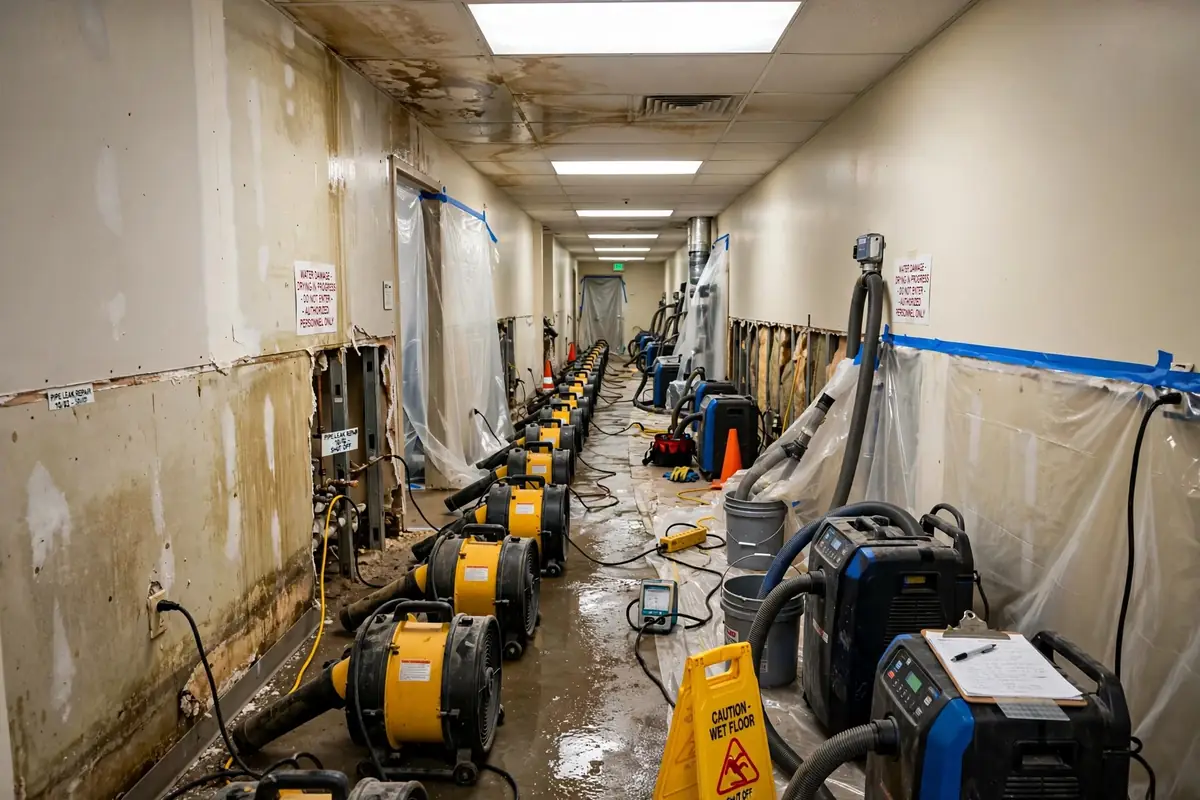
Common causes of water damage in Crystal Lake
- The lake itself. Crystal Lake is one of the best examples of a clear-water, groundwater-fed glacial lake in northeastern Illinois — and its level swings widely, with annual fluctuations of 2–4+ feet driven by precipitation and shallow-groundwater movement. Shoreline and lake-area homes inherit that volatility in their basements.
- High groundwater. The city sits over shallow glacial outwash aquifers with a high water table — during wet periods it has reached the surface in lake-area locations. Basements dry for years can start weeping when the water table rises.
- The August 2007 playbook. The 2007 storm sequence remains the template: record lake levels, Cove Pond overtopping North Shore Drive, emergency pumping, 60+ flooding complaints across four areas, and sanitary backups in Oriole Trail and along the south side. Every failure mode can recur in the next multi-day storm.
- Sanitary sewer backup during storms. Crystal Lake runs separated sanitary/storm systems with 27 sanitary lift stations and 3 stormwater stations — but the 2007 event proved that when groundwater and inflow overwhelm the system, sewage can back into homes in Oriole Trail and south-side neighborhoods. City code (2017 ordinance) now requires overhead sanitary sewer service for all new residential construction — an anti-backup measure for exactly this risk.
- Fox River overbank. The Fox River proper lies just east of the city, and April 2026 saw the river encroach on and close Rawson Bridge Road, with a nearby home photographed surrounded by floodwater. March–April 1960 was the most damaging Fox River watershed flood in modern records, and 2004, 2008, 2013, and 2017 all sent water this way.
- Sleepy Hollow Creek and storm damage. Sleepy Hollow Creek runs through the city's southern neighborhoods; summer storms bring the wind-and-tree threat too — on July 23, 2017, thunderstorm winds downed a 3-foot-diameter tree in Crystal Lake.
Frequently asked questions
What happened in Crystal Lake in August 2007?
A storm sequence — heavy rains August 5–9 and a 5-inch event August 19–23 — drove the lake to its highest level ever recorded, at or above the 890.9-foot spillway nearly all year. Cove Pond overtopped the road and closed North Shore Drive, the city pumped Cove Pond into the lake, 60+ residents filed flooding complaints, and sanitary sewers backed up in the Oriole Trail area and on the south side between Meridian Lane and Riverside Drive. It's the benchmark flood for every homeowner near the lake.
Where does Crystal Lake's water go?
The 230-acre lake outlets via Crystal Creek, which joins Boone Creek and ultimately the Fox River east of the city. Sleepy Hollow Creek, a Kishwaukee River watershed tributary, runs through the city's south side. During major storms, the Fox River rises from the east at the same time the lake is cresting — exactly what happened in the April 2026 Rawson Bridge Road flooding — so corridor homes face both sources at once.
Why do basements flood near the lake even without a storm?
Groundwater. Crystal Lake is a groundwater-fed glacial lake over shallow glacial outwash aquifers, and the lake level swings 2–4+ feet a year. In wet periods the water table reaches the surface in lake-area spots — hydrostatic pressure can push water through foundation walls and floor joints with no rain falling at all. If your sump runs constantly in spring, that's your sign.
What does the overhead sanitary sewer requirement mean?
City code (2017 ordinance) requires overhead building sanitary sewer services for all new residential construction. Overhead sewers pump wastewater up and out of the home rather than letting it flow by gravity below the level of the street main — so when the city main surcharges during a storm, sewage can't flow back downhill into the basement. It's Crystal Lake's code-level answer to the 2007 Oriole Trail backups.
Our Crystal Lake water damage services
Water extraction
Record lake levels, groundwater intrusions, Fox River overbank, sanitary backups, and burst pipes — high-capacity pumping for lake-area and corridor flooding alike.
Structural drying
Monitored dehumidification for lake cottages and early-20th-century homes, post-war ranch and split-level stock, and 1990s–2000s subdivisions — moisture-mapped and metered daily until dry.
Mold remediation
IICRC-standard containment, removal, and treatment where lake humidity, groundwater seepage, and flood moisture feed mold in basements, crawl spaces, and wall cavities.
Sewage cleanup
The 2007 Oriole Trail backups are the local template: category-3 extraction in full PPE, safe disposal of contaminated materials, and disinfection of every affected surface.
Storm damage repair
Wind- and tree-damaged roofing, siding, and windows are secured; rain intrusion is extracted, dried, and rebuilt to pre-loss condition.
Areas we serve in Crystal Lake
We respond 24/7 across Crystal Lake in ZIP codes 60012 and 60014 (area codes 779/815): the lake neighborhoods around North Shore Drive, Woodland Drive, Oriole Trail, Meridian Lane, and Riverside Drive; historic downtown around Dole Avenue and Main Street; and the subdivisions of Four Colonies, Turnberry, Wynstone, Royal Melbourne, Royal Ridge, Boulder Ridge, Rivershire, Cobblestone Woods, Woodlore Estates, Berkshire, Waterford, Cress Creek, and St. Andrews. We work around the Raue Center for the Arts, Three Oaks Recreation Area, Veterans Acres Park & Sterne's Woods, Lippold Park, the Main and West beaches, and the Prairie Trail. Call (773) 200-3228.
Our Crystal Lake restoration process
- Call (773) 200-3228 — day or night. Lake water, groundwater seepage, a sanitary backup, or a storm-torn roof — tell us what you're facing and we'll stage the right gear.
- Pin down the water's source and category. Lake and groundwater intrusion, Fox River overbank, sanitary backup, or a supply-line failure — each follows its own safety protocol and insurance path.
- Extract with containment. Pumps and extractors clear standing water fast; sewage and lake floodwater are isolated under containment from the start.
- Dry against the meter. Commercial air movers and dehumidifiers run until moisture readings confirm every material is dry — critical where groundwater keeps wicking into foundations.
- Sanitize, rebuild, and document. Flood- and sewage-contacted surfaces are disinfected, finishes restored to pre-loss condition, and photos, moisture logs, and itemized estimates are packaged for your adjuster.
Cost factors & insurance claim help in Crystal Lake
No flat quotes — every Crystal Lake loss is scoped on its facts. Cost depends on the water category (sanitary sewage and lake floodwater demand the most sanitation), how long the structure stayed wet, and how much porous material must go. The coverage map matters: lake and Fox River overbank flooding is flood-insurance territory, sewer backups typically need a sewer-backup endorsement, and sudden pipe failures usually fall under standard homeowners coverage. Given 2007's mix of record lake levels and sanitary backups in the same storm, we sort your coverage before work begins — then document everything and work directly with your insurer from first call to final walkthrough.
Water Damage in Crystal Lake? We Respond 24/7
Every minute counts. Rapid Water Damage Restoration Illinois dispatches certified technicians across Crystal Lake day and night — with insurance documentation handled for you.
Call (773) 200-3228 NowWater Damage Restoration Services in Crystal Lake
- Our water damage restoration service
- Commercial Water Damage Restoration in Crystal Lake
- Residential Water Damage Restoration in Crystal Lake
- Emergency Flood Cleanup in Crystal Lake
- Storm & Flood Damage Restoration in Crystal Lake
- Ceiling & Wall Water Damage Repair in Crystal Lake
- Sewage Backup Cleanup in Crystal Lake
- Mold Remediation in Crystal Lake
- Burst Pipe & Leak Water Damage in Crystal Lake
- Drying & Dehumidification in Crystal Lake
Nearby Areas We Serve Around Crystal Lake
Helpful Water Damage Guides
- Water Damage Restoration Cost in Illinois: What Really Drives the Bill
- How to File a Water Damage Insurance Claim in Illinois
Official resources: FEMA FloodSmart (flood insurance) and EPA guide to mold and moisture.