Collinsville's water problem is on file — literally. The city's Nutrient Assessment and Reduction Plan, filed with Illinois EPA under NPDES permit IL0028215, tabulates 18 municipal sewer-related events from 2012 through 2016 — a documented sanitary-sewer overflow and relief pattern. For homeowners, that paperwork means something concrete: when the system surcharges, basement backups are not a freak accident in Collinsville. They're a credible, recurring local risk.
Geography frames the rest. Collinsville — about 24,366 residents, 14 miles east of St. Louis — sits on the bluffs overlooking the American Bottom, the Mississippi River's historic floodplain. A 200-to-300-foot limestone and dolomite bluff line bounds that floodplain to the east, and the levee system below is maintained by the Southwestern Illinois Flood Prevention District Council — improvements successfully tested by the second-highest flood elevation on record in 2019. Collinsville itself drains through Cahokia Creek, and Illinois EPA's watershed history records 12 flooding-related federal disaster declarations in St. Clair County and major regional floods in July 1947, July 1951, April 1973, August 1993, and May 1995 — plus floods in 2008, 2011, 2013, 2014, and winter 2015–16. In the Cahokia Creek watershed, May is historically the most likely month for flash floods (60.5 percent of flash-flood events), with April leading for general floods (39.5 percent).
Self-billed the "Horseradish Capital of the World," home to the Brooks Catsup Bottle Water Tower and the UNESCO World Heritage Site of Cahokia Mounds at 30 Ramey Street, Collinsville mixes older bungalow and cape-cod homes near uptown with mid-century ranches, split-levels, and newer subdivisions to the east. When the creek rises or the sewer backs up — call (773) 200-3228. Rapid Water Damage Restoration Illinois answers 24/7.
Common Causes of Water Damage in Collinsville
- Sanitary-sewer overflow and relief events. The city's own EPA filing documents 18 municipal sewer-related events from 2012–2016 — a recurring pattern that makes basement sewage backups one of the most credible water risks in town.
- Cahokia Creek and bluff runoff. The watershed drains through Cahokia Creek; May historically brings 60.5 percent of the watershed's flash-flood events, and intense storms send fast runoff off the bluffs.
- Regional Mississippi flood pressure. The December 26–28, 2015 rains (six to ten-plus inches) crested the Mississippi at St. Louis at 42.58 feet on January 1, 2016 — its third-highest level on record — testing the American Bottom levee system Collinsville sits above.
- Older homes with aging laterals. Older bungalow and cape-cod homes near uptown carry aging water and sewer laterals and older foundations — the exact infrastructure that fails when the sanitary system surcharges.
- Severe storms and hail. The Metro East sees frequent severe thunderstorms; a May 2022 cycle brought 60-mph gusts and quarter-size hail to western St. Clair County — wind and hail damage that opens roofs to the next rain.
Areas We Serve in Collinsville
We serve all of Collinsville in ZIP 62234 (Madison and St. Clair counties, area code 618): Uptown Collinsville's historic commercial district along Main Street, the older bungalow and cape-cod neighborhoods near uptown, the mid-century ranch and split-level areas, and the newer subdivisions east of town. Our crews work around Cahokia Mounds State Historic Site at 30 Ramey Street, the Brooks Catsup Bottle Water Tower, and Miner's Theatre — and near Horseshoe Lake, with St. Louis's Gateway Arch about 14 miles west. Call (773) 200-3228 and a local crew heads your way.
Our Collinsville Restoration Process
- Call (773) 200-3228 — day or night. Sewage backups, creek-driven flooding, and storm-damaged roofs move to the front of our dispatch line.
- Classify the water. Clean, gray, or black — a sanitary backup, Cahokia Creek overbank, bluff runoff, or a failed pipe each demands its own protocol, and the classification frames your claim.
- Extract with full containment. Truck-mounted and portable equipment remove standing water fast; sewage and creek water are isolated under containment from the start.
- Dry to verified readings. Air movers and dehumidifiers target moisture-mapped walls, subfloors, and framing; daily meter readings — not touch — decide when each material is dry.
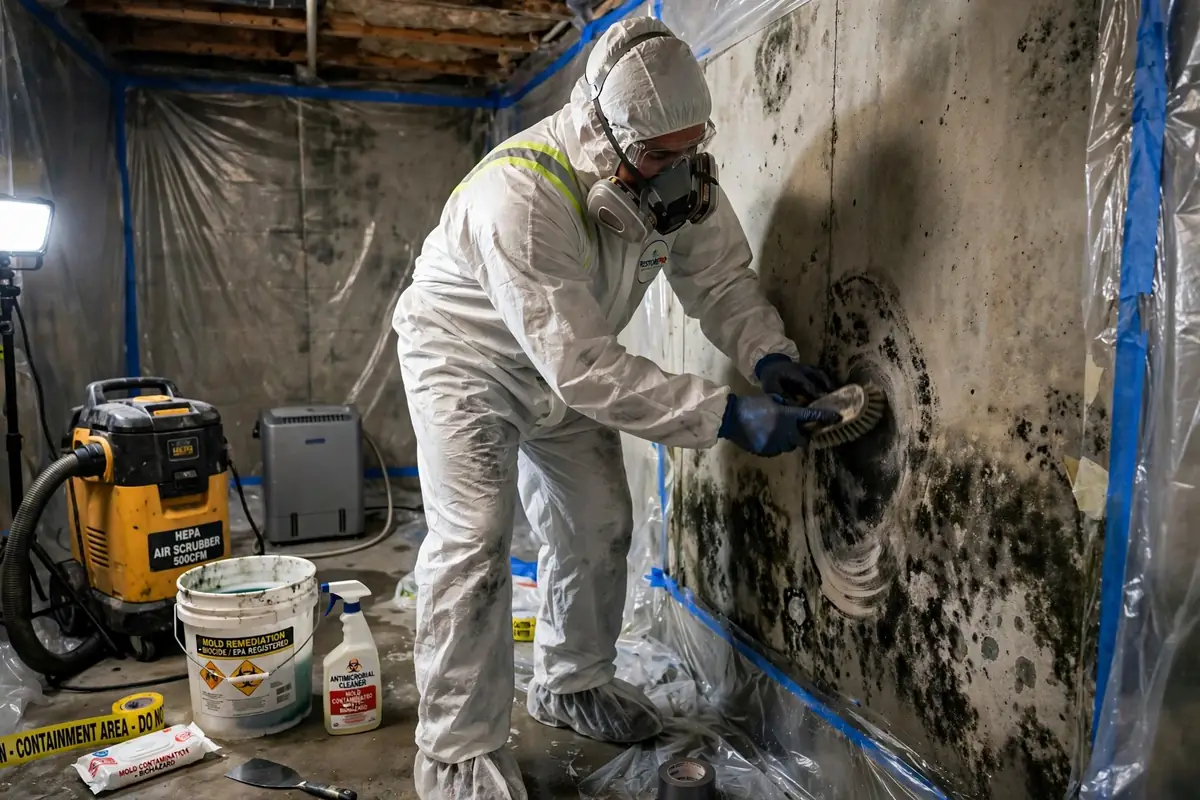
- Disinfect and block mold. Contaminated surfaces are sanitized and damaged porous materials removed before mold colonizes wall cavities and flooring.
- Rebuild and document. Finishes restored to pre-loss condition, with photos and moisture logs packaged for your adjuster.
Our Collinsville Water Damage Services
Water extraction
High-capacity pumping for flooded basements, sewer backups, and creek-driven intrusions — contaminated water handled under full containment.
Structural drying
Monitored dehumidification for bungalow, cape-cod, ranch, and split-level construction — moisture meters verify walls, subfloors, and framing.
Mold remediation
IICRC-standard containment, removal, and treatment for mold behind drywall and under flooring after floods and backups.
Sewage cleanup
With a documented local overflow pattern, this is a core Collinsville service: we extract category-3 water in full PPE, remove contaminated porous materials, and disinfect every affected surface.
Storm damage repair
Wind- and hail-damaged roofing, broken windows, and the water intrusion that follows — we seal the openings, extract the water, dry the structure, and rebuild.
Cost Factors & Insurance Claim Help
No flat pricing — your Collinsville loss is scoped on its facts: the water category (clean supply water versus creek floodwater, stormwater, or sewage), the square footage and materials affected, how long they stayed wet, and whether storm damage to the building envelope adds a roofing or siding scope. Sewer-backup losses hinge on a specific policy endorsement — worth checking given the city's documented overflow history — and riverine flood losses need their own coverage. We review your coverage, photograph and log everything, and work directly with your insurance company from first call to final walkthrough.
Frequently Asked Questions
What does Collinsville's EPA filing say about sewer overflows?
The city's Nutrient Assessment and Reduction Plan, filed with Illinois EPA under NPDES permit IL0028215, tabulates 18 municipal sewer-related events from 2012 through 2016 — one, three, five, seven, and two per year. That's a documented sanitary-sewer overflow pattern, not a one-off incident — and a strong reason to check that your homeowners policy carries a sewer-backup endorsement.
I live on the bluffs, not the floodplain — why should I worry about flooding?
Because your water comes from above. Collinsville sits on the bluffs overlooking the American Bottom, with a 200-to-300-foot limestone and dolomite bluff line bounding the historic Mississippi floodplain to the east. Intense rain sheets off the bluffs into Cahokia Creek and the storm-drain system — and in this watershed, May alone accounts for 60.5 percent of historic flash-flood events. Bluff-top homes get flash runoff; the floodplain below gets the river. Different water, same repair bill.
What happened during the winter 2015–16 Mississippi flooding?
The December 26–28, 2015 rains dumped six to ten-plus inches across Missouri and Illinois, and the Mississippi at St. Louis crested at 42.58 feet on January 1, 2016 — its third-highest level on record. The Metro East levees, which protect to a 54-foot river stage, held. Levees stop the river; they don't stop bluff runoff or sewer surcharge — Collinsville's own risks.
Why is May the flash-flood month here?
Per the EPA's watershed history for the Cahokia Creek area, May has historically produced 60.5 percent of flash-flood events, with April leading for general floods at 39.5 percent. Spring is when intense thunderstorm rain meets drainage already primed by seasonal wetness. If your basement has backed up or your street has ponded in a May storm before, assume the pattern can repeat.
I own an older bungalow near uptown. What water risks should I know about?
Uptown Collinsville's older bungalow and cape-cod homes carry aging water and sewer laterals, original supply lines, and foundations built before modern drainage standards — the exact infrastructure most vulnerable when the sanitary system surcharges. Add spring bluff-runoff flash flooding, and an older uptown home has two independent water risks. A sewer-backup endorsement and a working backwater valve are the two cheapest defenses.
Water Damage in Collinsville? We Respond 24/7
Every minute counts. Rapid Water Damage Restoration Illinois dispatches certified technicians across Collinsville day and night — with insurance documentation handled for you.
Call (773) 200-3228 NowWater Damage Restoration Services in Collinsville
- Our water damage restoration service
- Commercial Water Damage Restoration in Collinsville
- Residential Water Damage Restoration in Collinsville
- Emergency Flood Cleanup in Collinsville
- Storm & Flood Damage Restoration in Collinsville
- Ceiling & Wall Water Damage Repair in Collinsville
- Sewage Backup Cleanup in Collinsville
- Mold Remediation in Collinsville
- Burst Pipe & Leak Water Damage in Collinsville
- Drying & Dehumidification in Collinsville
Nearby Areas We Serve Around Collinsville
Helpful Water Damage Guides
Official resources: FEMA FloodSmart (flood insurance) and EPA guide to mold and moisture.