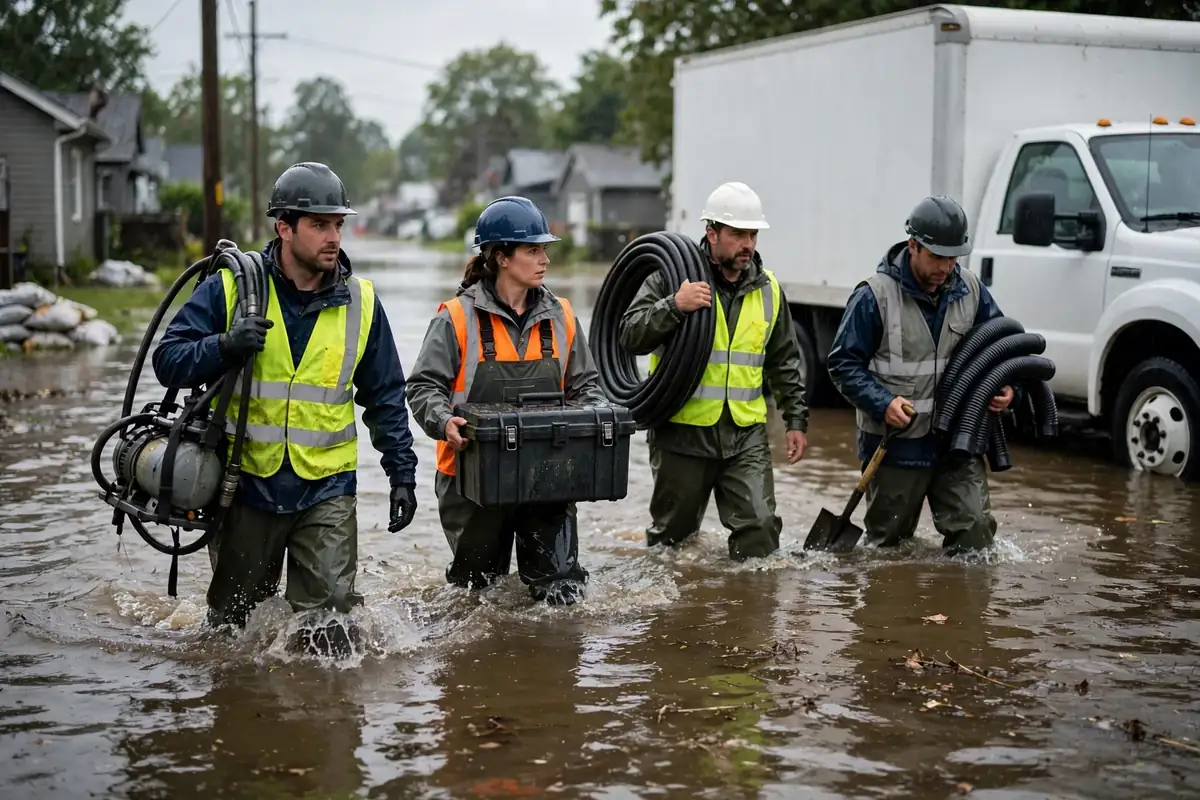
On September 17–18, 2023, nearly nine inches of rain fell within three hours on Chicago's south suburbs. Calumet City and Riverdale saw seven to nine inches — Dolton five to six, Midway Airport only two. Basements flooded across the area, and the damage was severe enough that President Biden issued a federal disaster declaration naming Burnham, Calumet City, Dolton, Harvey, and South Holland among the most affected communities. This followed separate June–July 2023 flooding that had already drawn a federal declaration. Nine inches in three hours: that's not a storm, it's a firehose pointed at every basement in town.
But the Center for Neighborhood Technology's RainReady guide describes a city "long plagued by chronic flooding" that has grown worse — and the numbers back it: from 2007 to 2011, Calumet City residents filed 4,620 flood-related insurance claims with over $12.6 million paid in damages. Residents suffer a mix of basement backup, street and yard flooding, overbanking from the Little Calumet River, and foundation seepage. Cook County identified the broader Calumet Corridor — in which Calumet City sits — as the area "most impacted and distressed" by the April 2013 storms (DR-4116). The September 2008 Little Calumet River flooding drew its own presidential disaster declaration, and USGS later built flood-inundation maps for the river from Lansing to South Holland. In 2016, a RainReady Calumet City Steering Committee formed to push green infrastructure on vacant lots, alleys, and concrete districts — the city knows its problem by name.
The Little Calumet River is the defining waterway, flowing along the city's south and southeastern edge, with Thorn Creek as the major tributary (USGS gage at Thornton). MWRD's Thorn Creek tunnel and reservoir system drains to the Calumet Water Reclamation Plant — regional infrastructure built for a different era's storms, now being rehabilitated piece by piece (the Calumet Intercepting Sewer, built in 1970, is being rehabbed via cured-in-place lining). The RainReady guide flags a culprit most homeowners never think about: faulty building sewers — the homeowner-owned lateral — aggravated by tree roots, grease, and deterioration blocking wastewater from leaving the house. And the housing stock is the classic Chicago freeze-loss profile: modest mid-20th-century bungalows and ranches, typically 1,200–1,300 square feet on small lots, the typical home dating to about 1961 — original plumbing stacks, aging clay laterals, and finished basements at high backup risk. When water gets in, Rapid Water Damage Restoration Illinois answers 24/7. Call (773) 200-3228.
Areas We Serve in Calumet City
All of ZIP 60409, Cook County: the River Oaks area around River Oaks Center (opened 1966 — original anchors Marshall Field's, Sears, Edward C. Minas), the Wentworth Avenue and Sibley Boulevard corridors, blocks near Sand Ridge Nature Center, Green Lake Family Aquatic Center, Veterans Memorial Park, the Thornton Fractional high school area, and neighborhoods bordering Burnham, Dolton, South Holland, Lansing, and Hammond, Indiana — about 25 minutes from downtown Chicago along I-94.
How We Restore Water-Damaged Homes in Calumet City
- Call (773) 200-3228 — day or night. We dispatch with extraction equipment, triaging active flooding and sewage backups first.
- Identify the water's source. Little Calumet overbank, Thorn Creek rise, sewer backup, failed building lateral, or burst pipe — the source sets the safety protocol.
- Extract under containment. Sewage and river water get protective protocols and containment before anything else is touched.
- Map hidden moisture. Meters and thermal imaging find water inside bungalow walls, under flooring, and in finished basements.
- Dry on a monitored plan. Air movers and dehumidifiers run on logged schedules with daily readings until materials hit their targets.
- Restore and document. Pre-loss repairs with a photo record your adjuster can build a file on, from first visit to final walkthrough.
Common Causes of Water Damage in Calumet City
- Little Calumet River overbanking. The river defines the city's southern edge; September 2008-style events and USGS flood-inundation mapping show the corridor's exposure.
- Thorn Creek flooding. The major tributary, with its own gauge at Thornton, feeds the same watershed during big storms.
- Basement backup from surcharged sewers. The chronic, documented pattern: 4,620 claims in five years, driven heavily by backups.
- Faulty building laterals. The homeowner-owned sewer lateral — blocked by tree roots, grease, and deterioration — is a key aggravator the RainReady guide flags by name.
- Foundation seepage. 1960s-era bungalows and ranches with aging foundations take groundwater in sustained wet spells.
- Street and yard flooding. Undersized or overwhelmed local drainage ponds water at foundations, where it finds its way in.
- Freeze-related pipe bursts. The 1950s–60s bungalow stock is the classic Chicago freeze profile: original water services, uninsulated crawl spaces and knee walls, hose bibs and irrigation never winterized. Frozen sump discharge lines flood in winter the same basements that flood in summer.
Our Calumet City Water Damage Services
Emergency water extraction
River flooding, sewer backup, sump failure, burst pipes — high-capacity pump-out with contamination protocols, day or night.
Sewage cleanup and sanitization
Chronic backup events demand professional extraction, sanitization, and disposal of contaminated porous materials.
Structural drying
Monitored drying for bungalow plaster, hardwood, and vintage finishes — verified with moisture meters.
Mold remediation
Wall cavities and finished basements grow mold within days of flooding. We contain, remove, and treat to IICRC standards.
Storm and freeze damage repair
From flood-damaged interiors to burst-pipe destruction, restored to pre-loss condition.
Frequently Asked Questions
What happened in September 2023?
Nearly nine inches of rain fell within three hours on September 17–18, 2023. Calumet City and Riverdale saw seven to nine inches; basements flooded across the area, and President Biden issued a federal disaster declaration naming Burnham, Calumet City, Dolton, Harvey, and South Holland among the most affected. It followed separate June–July 2023 flooding that had already drawn a federal declaration. Two federal disasters in one summer tells you everything about this city's exposure.
What do the 4,620 claims from 2007–2011 mean for me?
They're the documented proof that Calumet City flooding is chronic, not occasional: 4,620 flood-related insurance claims with over $12.6 million paid in damages in five years, per the Center for Neighborhood Technology's RainReady guide. The mix — basement backup, street and yard flooding, Little Calumet overbanking, foundation seepage — is the same mix homeowners still face. If your home flooded then, its risk profile hasn't changed unless the infrastructure around it has.
What's a "building sewer," and why does the RainReady guide blame it?
Your building sewer is the lateral pipe you own — from your house to the street main. The RainReady guide flags faulty building sewers as a key aggravator of foundation damage and basement flooding: tree roots, grease, and deterioration block wastewater from leaving the house. It's the pipe nobody thinks about until it fails — and in a 1961-vintage bungalow, it's likely original.
Does the Thorn Creek tunnel protect my basement?
MWRD's Thorn Creek tunnel and reservoir system is major regional infrastructure, draining to the Calumet Water Reclamation Plant — but it's designed to manage watershed-scale flows, not your lateral. The 2023 floods happened with that system in place. Regional tunnels reduce overbank flooding; they don't stop sewer backups into individual basements.
My bungalow's basement floods every winter too. Why?
Because the same 1950s–60s bungalow profile that floods in summer freezes in winter: original water services, uninsulated crawl spaces and knee walls in bungalow attics, hose bibs and irrigation never winterized — plus frozen sump discharge lines, which flood in January the same basements that flood in July. It's a year-round risk profile, and it deserves a year-round protection plan.
Cost Factors & Insurance Claim Help
No flat quotes — every Calumet City loss is scoped on its facts: water category, square footage affected, materials involved, and how long they stayed wet. Sewage-contaminated losses cost more than clean-water ones; finished basements multiply scope. Coverage often hinges on a sewer-backup endorsement or flood-versus-sewer distinctions — critical here, where federal disaster declarations and chronic backup overlap. We review your policy with you, document with detailed photo logs and moisture readings your adjuster can build a file on, and work directly with your insurance company from the first call to the final walkthrough.
Water Damage in Calumet City? We Respond 24/7
Every minute counts. Rapid Water Damage Restoration Illinois dispatches certified technicians across Calumet City day and night — with insurance documentation handled for you.
Call (773) 200-3228 NowWater Damage Restoration Services in Calumet City
- Our water damage restoration service
- Commercial Water Damage Restoration in Calumet City
- Residential Water Damage Restoration in Calumet City
- Emergency Flood Cleanup in Calumet City
- Storm & Flood Damage Restoration in Calumet City
- Ceiling & Wall Water Damage Repair in Calumet City
- Sewage Backup Cleanup in Calumet City
- Mold Remediation in Calumet City
- Burst Pipe & Leak Water Damage in Calumet City
- Drying & Dehumidification in Calumet City
Nearby Areas We Serve Around Calumet City
Helpful Water Damage Guides
- What to Do When Your Basement Floods: A Step-by-Step Emergency Guide
- Does Homeowners Insurance Cover Water Damage in Illinois?
Official resources: FEMA FloodSmart (flood insurance) and EPA guide to mold and moisture.